

By Janet Kanters
Scientists at the National University of Singapore (NUS) have developed a dissolving microneedle patch that delivers living biofertiliser straight into plant tissue, offering a more precise alternative to soil inoculation and a potential boost for urban and high-value crop production.
In greenhouse trials, leafy vegetables including choy sum and kale grew faster and larger when treated with the microneedle system, while using only 10 percent of the original biofertiliser dosage. Gains were measured across shoot biomass, leaf area and plant height.
The work, led by Assistant Professor Andy Tay from NUS’s Department of Biomedical Engineering and iHealthtech, was published in Advanced Functional Materials.
“Biofertilisers are usually added to soil, where a lot of the microbes never reach the roots because they face competition from native microbes and harsh soil conditions,” Tay said. “By delivering beneficial microbes directly into the plant’s tissues, we can bypass those hurdles and achieve faster, more consistent results.”
From biomedical delivery to agritech
The concept draws on delivery technologies originally developed for healthcare. Tay said the idea took shape during the COVID-19 pandemic, when food supply disruptions highlighted Singapore’s vulnerability as a land-scarce nation.
“During the pandemic, Singapore had food security pressure because countries stopped selling chicken and rice to us,” he said. “My main research is on delivery sciences, and we had previously developed microneedles for wound healing. We repurposed the microneedles for agritech applications, and it works perfectly.”
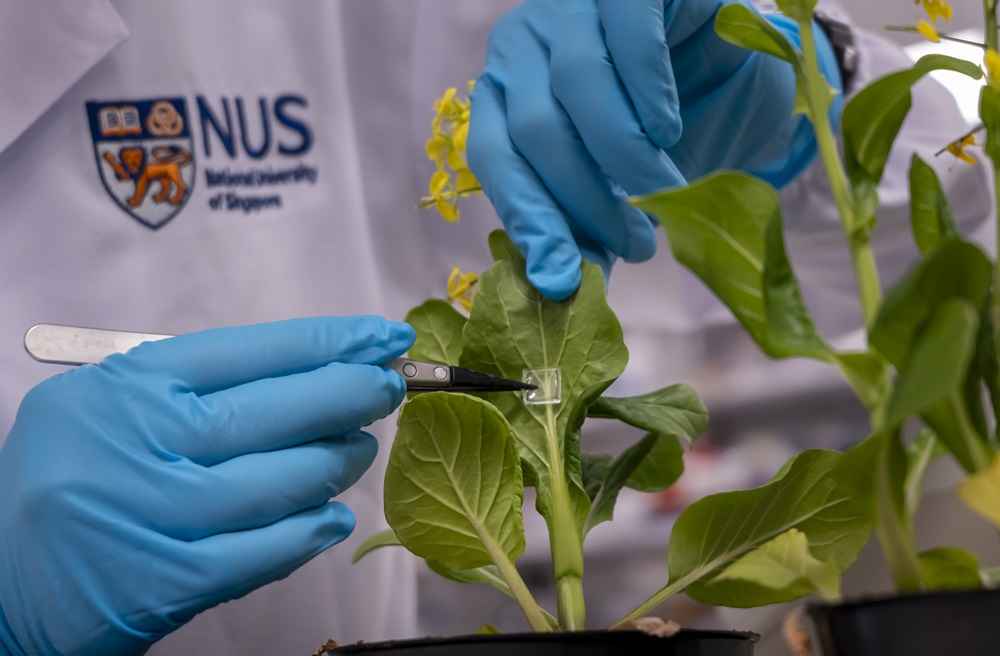
The team fabricated plant-specific microneedles from polyvinyl alcohol (PVA), a biodegradable and low-cost polymer. For leaves, a 1 cm by 1 cm patch carries a dense array of microscopic pyramids about 140 micrometres long, while thicker stems are treated with longer needles arranged in short rows. Beneficial bacteria or fungi are mixed into the polymer and embedded in the needle tips.
Applied with a thumb or a simple handheld applicator, the microneedles penetrate the leaf or stem and dissolve within about a minute, releasing their microbial payload. Laboratory tests showed minimal disruption to plant tissue, with temporary indentations fading within hours and stress markers returning to normal within a day.
Better control, less waste
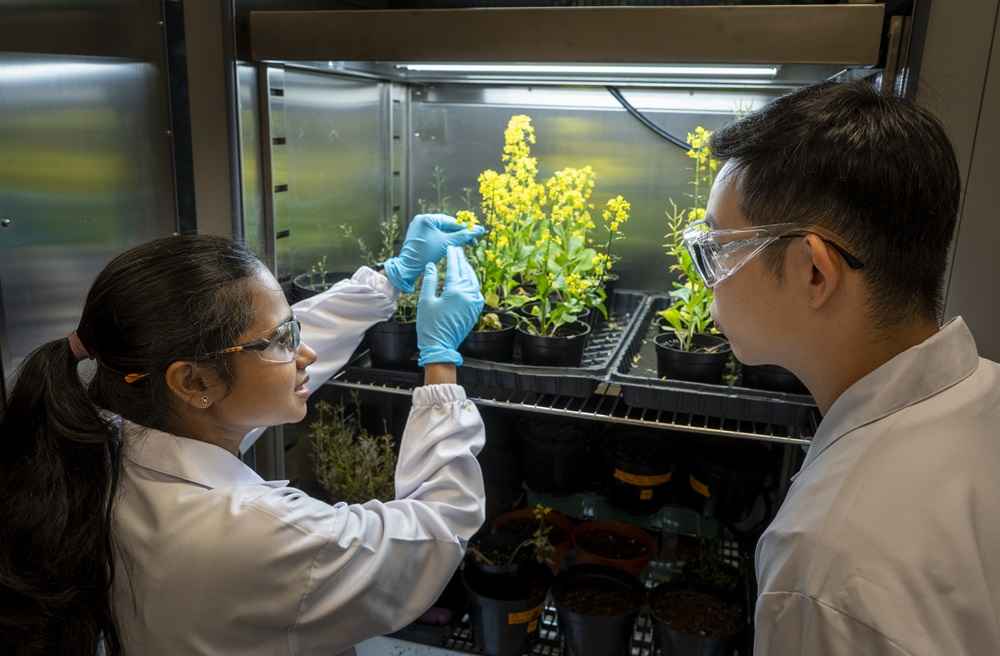
Using a cocktail of plant growth-promoting rhizobacteria (PGPR) including Streptomyces and Agromyces-Bacillus, the researchers showed that direct delivery through leaves or stems outperformed soil treatments. The microbes migrated from the injection site to the roots within days, where they shifted the root microbiome towards a more beneficial balance without destabilising it.
“With the microneedles, we are able to deliver biofertilisers directly,” Tay said. “This avoids problems such as unwanted escape of non-native bacteria, competition with the endogenous microbiome and the inability to control dosage per plant.”
In fact, the team found that plants responded in a dose-dependent way up to a clear ceiling, allowing growers to identify the lowest effective dose. According to Tay, the system enabled comparable or better growth using as little as 10 percent of the original biofertiliser dosage in some cases.
The reduction in inputs also has environmental implications. “Biofertiliser run-off is a significant environmental hazard because it can lead to eutrophication,” Tay said. “Microneedles deliver the biofertilisers directly into plants, so it minimises unwanted environmental run-offs. The dosage needed is also much lower, which further reduces waste.”
Beyond bacteria, the researchers also demonstrated delivery of beneficial fungi. Microneedle patches loaded with a Tinctoporellus strain promoted choy sum growth and helped regulate plant hormone levels, supporting balanced development.
“This work is the first to demonstrate that root-associated biofertilisers can be directly delivered into a plant’s leaves or stems to enhance growth,” Tay said. “We are introducing a new concept of microneedle biofertiliser that overcomes major limitations of soil inoculation.”
Fit for urban farms and automation
The NUS team sees near-term opportunities in urban and vertical farming systems, where precise dosing and uniformity are critical. A 3D-printed applicator used in the study ensured even insertion across large leaf areas and points toward robotic deployment.
“The microneedles can be integrated with a robotic clamp, which we have shown in the paper,” Tay said. “As robots become more common in urban farming, they can apply microneedles routinely and automatically without human intervention.”
Cost and scalability were also addressed. Each patch costs about USD 0.10 to produce and can be stored for at least a month under refrigeration, enabling advance preparation and low-cost deployment. While current delivery takes around 30 seconds per application, Tay expects material innovations to shorten that time.
One unexpected benefit, he added, is speed to harvest. “If we apply biofertilisers with microneedles, plants need less time to grow than with soil application,” Tay said. “In situations like impending storms or typhoons, this could help farmers harvest earlier and reduce crop losses.”
Looking ahead, the team plans to focus on automation, faster-dissolving materials and trials in a wider range of crops, including high-value and medicinal plants where controlled dosing can be more easily justified.
“Agriculture is one of the sectors most affected by climate change, yet there has been little innovation to enhance the climate resilience of plants,” Tay said. “Our goal is to use bioengineering approaches to help crops grow better under increasing stress. I would be extremely happy if this work helps us connect with farmers and companies interested in trying the technology.”










 Facebook
 Twitter
 Instagram
 LinkedIn
 YouTube