


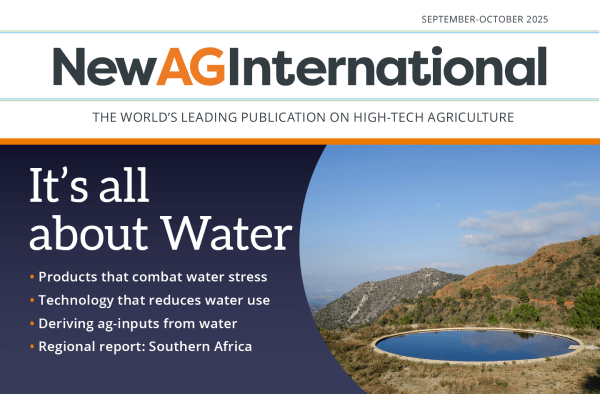
Water – that was the theme for our September/October 2025 issue of New AG International. Our industry is looking to answer one of agriculture’s most pressing questions – how do we make this vital resource go further?
This is another must-read issue from the New AG editorial team – click here to discover more!
• Technology that reduces water use – see Aqualatus
• Products that combat water stress
• Deriving ag-inputs from water – see Drop Goal
• Turning polluted water into fertilizer
• Regional report: Biologicals gain ground in Southern Africa
• Leader Profile: Fyteko – priming crops against abiotic stress
Here is a round-up of the main features with a link:
BIOSTIMULANTS
Unlocking the black box of plant biostimulants
‘Unlocking the black box of plant biostimulants’ is the intriguing title of an editorial in the academic journal Scientia Horticulturae. The paper argues for a shift in how plant biostimulants are characterized and evaluated, and for that shift to better reflect their role as functional tools in broader fertilization strategies. Yield cannot be the only indicator of efficacy is the repeated message. Read.
“Despite the rapid growth of this sector, there is still confusion about definitions, evaluation methods, and how to build credibility. We felt it was important to bring these points together and emphasise a shift from product identity to function, and from yield alone to broader measures of resilience and plant health.” Petronia Carillo, Full Professor of Agronomy at the University of Campania “Luigi Vanvitelli” Caserta Italy
The paper elaborates that plant biostimulant products do not directly stimulate growth like fertilizers or pesticides. “They support internal functions such as root development, antioxidant defence, and nutrient redistribution. Their effects are subtle, shaped by environmental conditions, and may not lead to immediate biomass increases.”
The authors are clear: “Validation should include both efficacy data and an explanation of how products achieve agronomic benefits.”
Deep-dive interview:
New AG International spoke to Dr Nicole Hart, CEO of biostimulant producer Afrikelp, to get her perspective on ‘Unlocking the black box of plant biostimulants’ (see article above) and her thoughts on water-use efficiency given the theme of this issue. Here
Drop Goal
Inspired by our water theme for this issue, New AG International looks at a partnership between two Dutch companies – one a provider of agricultural inputs and another being the largest drinking water company in The Netherlands. Their collaboration has produced a fulvic acid product that is extracted during the water purification process. Here
Featuring: Den Ouden Groep, Vitens
Elicit Plant targets global growth with breakthrough crop resilience technology
As the agriculture sector grapples with climate volatility and mounting water scarcity, ag tech innovator Elicit Plant is positioning itself at the forefront of solutions for broad-acre crops. Leveraging a patented technology based on naturally derived phytosterols, the company has demonstrated the ability to reduce water use by up to 20 percent and increase yields by an average of 10 percent – a proposition that speaks directly to farmers’ profitability as well as global food security. Here
Elicit Plant is accelerating its international rollout with dedicated products for staple crops including maize, wheat, soybean, sunflower, and barley. The firm’s EliTerra technology has already secured adoption across Europe, Brazil, and the United States, where it is present in 20 states.
Elicit Plant has taken an unusual path in the ag tech space: moving rapidly from scientific discovery to large-scale market adoption. Its foliar-applied products are designed for easy integration into existing farm practices, a feature that has helped accelerate uptake across diverse regions and cropping systems.
Elicit Plant is preparing to deepen its footprint in key agricultural markets. Expansion efforts are supported by regulatory approvals already secured in the EU, Ukraine, the U.S., and Brazil, alongside strong demand signals from growers contending with climate-induced risks.
Water stress? Next-gen biostimulants offer a lifeline
Drought is affecting many areas limiting farmers’ ability to grow productive, healthy crops. However, biostimulants could provide the answer. Specialists with ICL Growing Solutions explain.
“…biostimulants are an emerging tool to enhance climate resilience. They help plants withstand abiotic stresses like drought, extreme temperatures, and high soil salinity by strengthening plants’ natural defence mechanisms and modulating metabolic pathways of stress response.”
“We have an unlimited number of molecules that exist in nature, and we need to discover their potential in agricultural practice.”
During production, from a vast amount of substances, ICL’s molecular distillation technology ensures that only the most effective and beneficial compounds are utilised as part of its biostimulants formulation, leading to superior plant growth, resilience, and overall agricultural success.
Agriculture has changed massively over the years, through the eras of applying soil physics, then chemistry, and most recently biology to farming systems. “Looking ahead it’s about bringing them all together, and developing new molecules to benefit plant physiology, which is essential to improve crop productivity.”
PLANT PROTECTION
Biocontrol breakthroughs offer hope in fight against Asian longhorned beetle
A new scientific review suggests there are promising biological alternatives to combat Asian longhorned beetle (ALB), a highly destructive tree pest that has threatened North America’s hardwood forests for nearly three decades.
COMPANY STRATEGY
Water, a vital challenge for sustainable agriculture: Éléphant Vert’s response
Elephant Vert believes that water management cannot be separated from soil health and plant resilience. It outlines here how its biosolutions are part of a regenerative agriculture approach, where every intervention aims to do more with less, particularly with water.
PRODUCTS AND TRENDS
Trailblazer Technologies: Turning polluted water into fertilizer
Trailblazer Technologies was founded in 2008 by three shareholders who have collectively more than 110 years of experience in the fertilizer industry. Their initial project used pulse combustion technology to produce soluble fertilizers with superior non-caking properties.
Recognizing the growing challenge of acid mine drainage (AMD) – known as acid rock drainage (ARD) in the U.S. – Trailblazer Technologies shifted focus to water recovery. Trailblazer Technologies developed the KNeW process (Potassium Nitrate ex Waste), which not only avoids any brine creation but also converts the pollutants into valuable fertilizers at, usually, no net cost of operation. This breakthrough has been patented across numerous mining jurisdictions. Trailblazer Technologies has pioneered a process that simultaneously helps in the solution of two global challenges: polluted water and fertilizer demand. By converting AMD and brackish sources into demineralized water and marketable fertilizers, the KNeW and ZIX-Zak processes replace waste with value.
Canadian researchers tap into nature to turn dairy wastewater into liquid gold
In the face of increasing drought and water shortages, an innovative new research project is tapping into the power of nature to help Canadian dairy farmers treat wastewater and reuse it for crop irrigation.
IRRIGATION
How can we use less water when irrigating?
Introducing a water-saving technology – called Aqualatus – that can cut irrigation volumes by 50% while protecting yields.
• Low dose liquid formulation
• Works with existing irrigation systems, including pivot
• Minimizes evaporation, leaching, run-off
• Harmless to environment
• Provides stronger holding capacity around roots
• Also reduces usage of fertilizers, agri-inputs and electricity …
• … reducing costs further
Engage Crop Solutions can support its claims with more than 300 field trials across 17 countries and has built a successful trial portfolio by building a network of partners who conduct trials. Read
U.S. irrigation equipment exports hold strong but face tariff uncertainty
The U.S. irrigation equipment industry has long enjoyed a competitive advantage in manufacturing and global exports. But as trade policy continues to shift under the Trump administration, the sector is bracing for potential turbulence from retaliatory tariffs in key markets. Here
Salty Soil: Solving a tough irrigation challenge
As world population rises, demand for water grows and droughts become more common, the need to boost crop production through innovative approaches is clear. A look at exciting irrigation studies on several species, and also how halophytes fit into the picture. Halophytes are the group of plants with intrinsic salt tolerance – but what is the potential to develop some of them as a food source? Here
Kleinskuur Aquaponics – a South African pioneer looking to export to the MENA region
Founded 10 years ago by husband-and-wife team Colin and Annemarie Bremner, Kleinskuur Aquaponics has developed a robust and scalable aquaponic system, now used throughout Africa.
“In our system, fish waste is converted by bacteria into nitrates that plants use to grow. This is known as the nitrification process and takes about 40 days to establish. Once balanced, we maintain the system through staggered production of fish and plants.”
“Our systems are closed-loop and self-cleaning – no need to dump water. Once filled, water is only topped up for what’s lost to evaporation or plant use.”
“Our goal is zero waste. For example: instead of discarding fish innards, we feed them to black soldier fly (BSF) larvae. Plant waste (stems, leaves, roots) also goes to the BSF unit. The larvae can be used as raw chicken feed or dried and processed into fish feed. Oils released during drying can be sold separately.” Here. Featuring: Colin Bremner / Annemarie Bremner
Surface water as an irrigation source: Treatment and system choices
With increasing scarcity of good irrigation water, the need for alternative sources is growing. Surface water is increasingly seen as a promising option worldwide, but because of its variable composition, it requires customized research, assessment and treatment. A white paper by Van der Ende Group describes the technical and process steps required to successfully use surface water as an irrigation source.
LEADER PROFILE
Fyteko – in prime position
Founded in Belgium in 2014 by Guillaume Wegria and Dr. Juan Carlos Cabrera, Fyteko, is a pioneering company in the field of agri-biosolutions. Its proprietary technology platform enables the creation of agricultural biomolecules – including biostimulants (foliar spray and seed treatment), herbicide bioenhancers, and biocontrol solutions – that enhance crop performance and resilience, particularly against climate-induced stress like drought or heat. Here
REGIONAL REPORT
Biologicals gain ground in Southern Africa
Increasingly stringent regulations on maximum residue levels (MRLs) in export markets is driving growth in biopesticides in Southern Africa. As these prove their worth, the road is being paved for biostimulants and biofertilizers to enter the fore. Here
AGRONOMICS AND ECONOMICS
The microscopic power beneath our feet — How soil biology testing is changing farming from the ground up
Soil biology has long been the hidden engine of agriculture. Now, thanks to cutting-edge DNA testing developed by Waypoint Analytical, scientists and farmers alike are unlocking a new understanding of the soil microbiome – one that promises smarter nutrient use, improved crop yields, and long-term soil health. Here
Wheat roots found to actively shape their microbiomes, offering hope for drought-resilient crops
Wheat plants are doing more than just growing – they’re quietly engineering the microscopic ecosystems that live on and within their roots, according to groundbreaking new research that could transform how crops are grown in a changing climate.
A team led by Dr. Tim C. Paulitz of the USDA Agricultural Research Service (USDA-ARS) and Dr. Olga Mavrodi of Washington State University has uncovered how wheat plants influence and reshape their root microbiomes depending on environmental conditions, including drought and irrigation. Here
PEOPLE
Groundwork BioAg appoints Alon Weber CEO
FMC Corporation names Brian P. Angeli president of North America
Ceradis appoints global leaders: Lon Kreger has been appointed vice president of the Americas and Oceania regions / Robert Nemeth has been appointed vice president of the EMEA regions
Indigo Ag appoints David Nothmann as global head of biologicals
Micropep Technologies appoints Georg Goeres as CEO
Geraldo Mattioli joins Kula Bio as chief commercial officer
BioWorks strengthens R&D team with biological control expert: Glen Stevens, Ph.D., has joined BioWorks as a research and development associate
Meristem Crop Performance has appointed Guillermo Bort as vice president of international business development.
FMC Corporation names Leonardo Bastos as chief marketing officer
Futureco Bioscience appoints María José Lis as CCO
BRANDT welcomes Mauricio Andriao as vice president
Verdesian Life Sciences appoints RK Goyal as head of Asia commercial operations
Yara North America appoints Sabine Schröder as president
Azotic Technologies appoints Sander Pabbruwee as CEO
Switch Bioworks – Steve del Cardayre, PhD, joins as chief technology officer (CTO)
Brett Boghigian, PhD, joins Switch as chief business officer (CBO)













 Facebook
 Twitter
 Instagram
 LinkedIn
 YouTube