


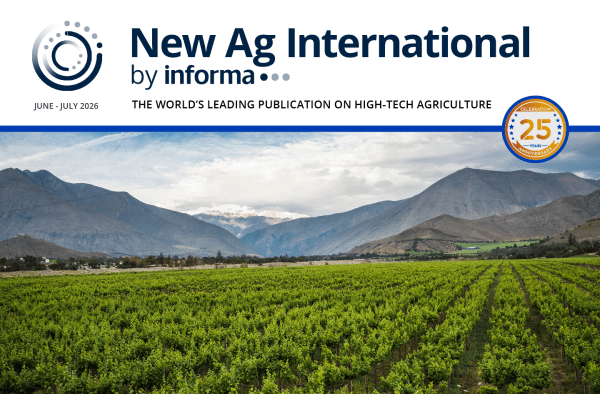
Review of June/July 2026 issue New AG International
Editor, Janet Kanters
For years, much of the conversation around biological crop protection has focused on discovery. The industry has celebrated new microbial strains, novel modes of action, and promising natural compounds that could help growers reduce reliance on conventional chemistry while maintaining productivity.
Yet as the biologicals sector matures, a different challenge is taking centre stage: formulation.
Finding a promising microorganism, plant extract, or naturally derived active ingredient is only the beginning. The real test lies in turning those discoveries into products that can be manufactured consistently, stored reliably, transported economically, and delivered effectively under real-world farming conditions.
Several stories in this issue highlight how the biologicals industry is increasingly shifting its attention from discovery to deployment.
France-based Agriodor offers one example. The company recently secured €15 million in funding to expand its scent-based crop protection technology, which uses naturally occurring plant odours to influence insect behaviour. The concept itself is innovative, but what makes the development particularly significant is the company’s success in moving semiochemical technology from research into practical field applications. Agriodor’s work demonstrates that future crop protection solutions may not always come from new active ingredients alone. Sometimes innovation lies in how biological signals are packaged, stabilized, and delivered to achieve consistent field performance.
In our feature ‘Formulation for Biologicals’, we examine the key requirements when formulating with biologicals, whether it is a microbe or a plant extracts. We ask industry experts what problems to avoid, and what they see as the scope for future developments. Story, here. For a comprehensive review, download the Croda white paper, here, on Formulating biologicals for Agriculture, and learn more about what this company is doing to drive the application of biologicals.
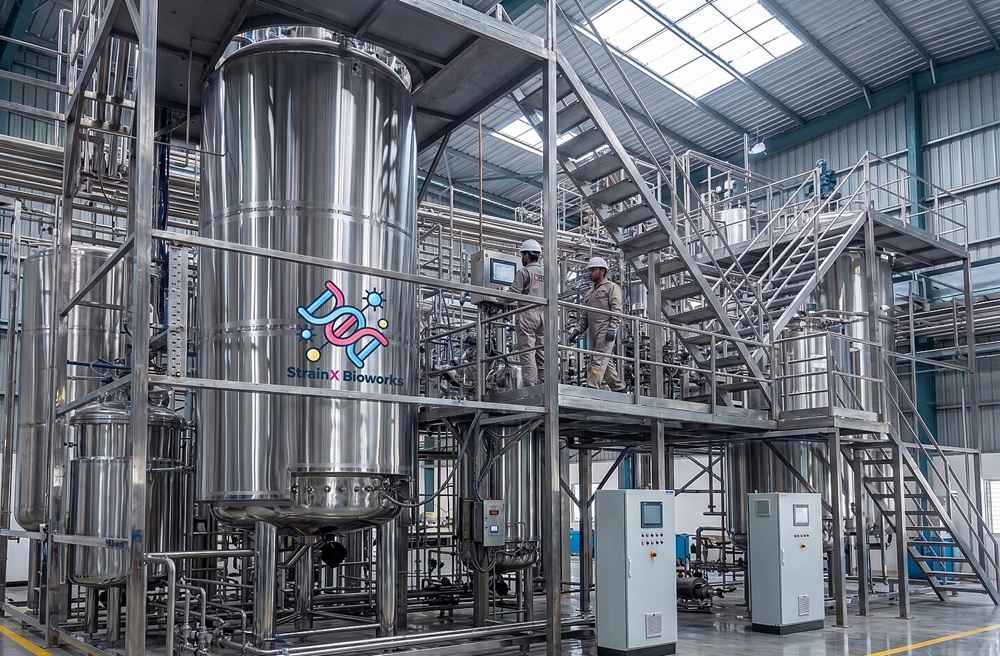
The same theme emerges at Rovensa Next, where a new pilot fermentation facility in Brazil has been designed specifically to bridge one of the most difficult gaps in biological product development: scaling up. Researchers have long known that microorganisms often behave differently when fermentation moves from laboratory vessels to commercial-scale production. A strain that performs well in a small reactor may encounter entirely different challenges when produced in thousands of litres.
The company’s investment recognizes that formulation and manufacturing processes are no longer secondary considerations. They are fundamental components of product development. By creating an intermediate step between laboratory research and industrial production, Rovensa Next is addressing a reality that every biologicals developer faces: a product’s commercial success depends as much on scalability and consistency as on biological performance.
BASF Agricultural Solutions is reaching a similar conclusion from a different direction. The commissioning of its new fermentation facility in Germany reflects growing confidence in biological crop protection, but it also underscores the importance of production infrastructure. Bringing fermentation capabilities in-house allows closer integration between research, development, and manufacturing. It creates the flexibility needed to scale biological products while maintaining quality and supply reliability.
This focus on formulation extends beyond microbial products.
In this issue, we also examine the growing role of marine resources in agriculture. Seaweed-based biostimulants continue to gain momentum, and Cascadia Seaweed’s new processing facility in British Columbia highlights the importance of building integrated supply chains that stretch from cultivation through extraction and final product manufacturing. Once again, success depends not simply on access to raw materials but on the ability to process and formulate them into reliable products for growers.
Meanwhile, researchers in Norway are exploring a very different marine resource: sea urchins harvested from coastal ecosystems damaged by urchin overgrazing. Early greenhouse results suggest sea urchin-derived biostimulants may offer agricultural benefits while contributing to marine restoration efforts. Although the concept remains in development, researchers are already confronting familiar questions about stabilization, shelf life, processing, and regulatory compliance. The story serves as another reminder that innovative biological inputs ultimately succeed or fail based on their ability to move beyond the laboratory.
Soil health remains another major theme shaping agricultural innovation. Researchers at the University of Queensland have demonstrated that RNA-based biopesticides applied to leaves can move throughout plants, including into root systems. The discovery could expand opportunities to manage soilborne pests and diseases while reducing reliance on conventional pesticides. As RNA technologies become more commercialized, formulation will once again play a critical role in protecting these molecules and ensuring effective delivery under field conditions.
Precision agriculture is also entering a new chapter. Rather than simply collecting data, platforms are increasingly helping farmers interpret and act on information. New AI-powered tools from OneSoil and Intelinair’s AGMRI platform are designed to translate satellite imagery, weather data, soil information, and historical field records into practical recommendations. The focus is shifting from data generation to decision support, helping growers navigate increasingly complex management environments.
Elsewhere in this issue, readers will find examples of innovation emerging across products and trends. In Brazil, researchers are exploring struvite technology to convert swine manure into slow-release phosphorus fertilizer, creating new opportunities for nutrient recycling and reducing dependence on imported fertilizer sources. The work reflects broader industry interest in circular economy approaches that connect waste management, nutrient recovery, and crop production.
Water management continues to evolve as well. Advances in nanobubble technology are showing promise in greenhouse and orchard production systems, where improved oxygen delivery, cleaner irrigation networks, and enhanced water-use efficiency can contribute to stronger crop performance. In other news, researchers at the University of California, Riverside, have developed a robotic system capable of mapping soil moisture on a tree-by-tree basis in orchards. The technology reflects the continuing convergence of sensors, robotics, and precision agriculture as growers seek ways to optimize irrigation under increasing water constraints.
Related advances are occurring in greenhouse and controlled-environment agriculture. Wageningen University & Research has launched HortINspire, a global network designed to accelerate collaboration and knowledge exchange in controlled-environment production systems. Meanwhile, vertical farming company Oishii continues to attract major investment as it expands its robotics-enabled indoor strawberry production model. These developments highlight the growing role of technology integration in high-value crop production.
Our agronomics coverage examines how plants interact with soil microbial communities and how new sensing technologies can detect crop stress before visible symptoms appear. Together, these studies reinforce a growing understanding that successful crop management increasingly depends on understanding complex biological systems and responding proactively rather than reactively.
Finally, our regional report focuses on Chile, one of the world’s most dynamic fruit-exporting nations. The report reveals how precision fertigation, specialized fertilizers, biostimulants, and biological inputs are becoming standard tools in high-value fruit production. Chile’s rapid adoption of these technologies offers a glimpse of where many agricultural systems may be heading: toward greater precision, higher efficiency, and increasing integration of biological solutions.
Across all of these topics, a common thread emerges. Agriculture is moving beyond the search for individual breakthroughs and toward the systems required to make innovation work at scale.
Whether the subject is microbial fermentation, scent-based crop protection, seaweed extraction, precision technology, irrigation management, or greenhouse production, the challenge is increasingly the same: turning promising ideas into practical tools that deliver measurable value on the farm.
That is why formulation matters.
It is no longer simply a technical step between discovery and commercialization. It has become one of the industry’s most important drivers of innovation – and perhaps one of the clearest indicators of where agricultural technology is headed next.
Browse issue contents here, free to view.










 Facebook
 Twitter
 Instagram
 LinkedIn
 YouTube