


By Janet Kanters
Researchers at The James Hutton Institute have reported encouraging results from a glasshouse study testing whether sugar kelp extracts can help crops use nutrients more efficiently when fertiliser inputs are limited.
The work forms part of Assessing Sugar Kelp Extracts as a Nutrient Management Tool (SKE-NMT), a collaborative project led by Algapelago Marine Ltd with support from Innovate UK and industry partners. The project brings together kelp cultivators Atlantic Mariculture Ltd, researchers at the James Hutton Institute, and the UK Agri-Tech Centre.
The glasshouse trial focused on two key challenges in crop nutrition: nitrogen limitation in barley and phosphorus limitation in beans. Early results suggest that kelp-based biostimulants could play a role in maintaining yields while reducing fertiliser use.
“The glasshouse trial is now completed and initial results indicated that the tested new seaweed extracts all had significant positive effects on barley grain yield at certain nitrogen levels,” said Dr. Gordon McDougall, Head of the Plant Biochemistry and Food Quality Group at the James Hutton Institute. “This is an excellent result, and we hypothesise that this indicates an improvement in how the barley plants assimilate and use nitrogen.”
According to McDougall, all three sugar kelp extracts tested substantially increased barley grain yield at both the full recommended nitrogen rate and at 66 percent of that rate. “This represents a considerable increase in yield and at a substantial reduction in applied N,” he said. Notably, the yield response was not linked to visible changes in crop growth habits. “There were no obvious differences in growth habits, tiller numbers, or other phenotypes,” he added.
Low-energy processing and cultivated kelp
A central part of the project is the development of sustainable extraction and preservation methods for sugar kelp (Saccharina latissima). Atlantic Mariculture has led this work, refining wet processing techniques that avoid energy-intensive drying or milling. The approach allows year-round production while maximising recovery of bioactive compounds and minimising waste.
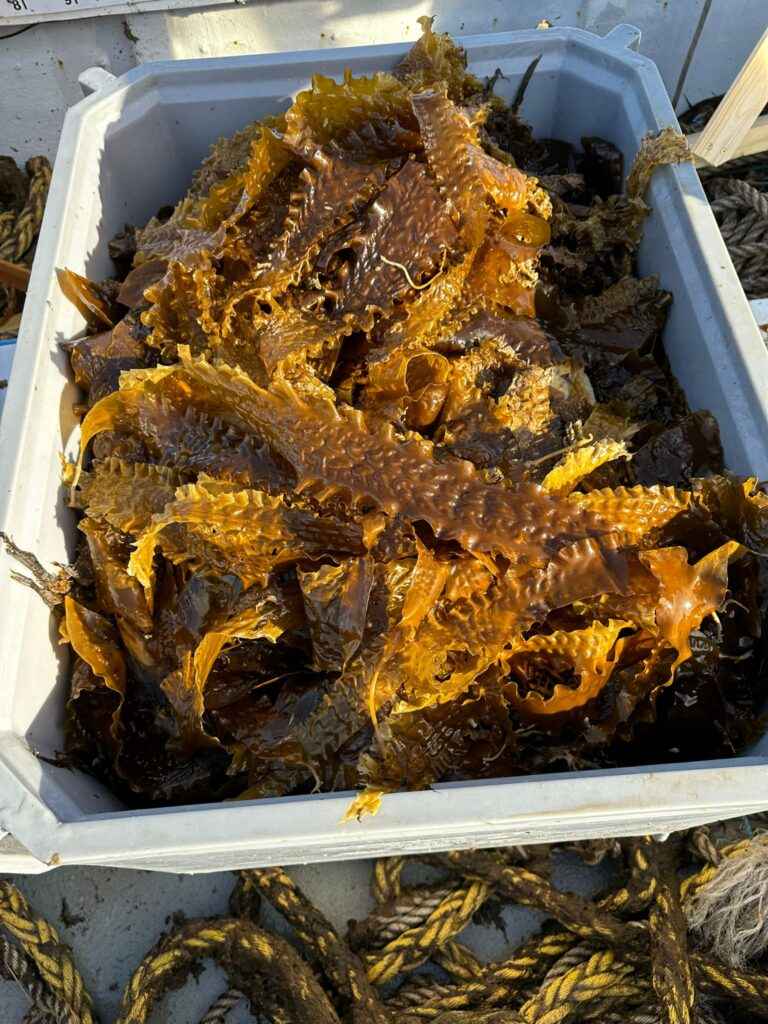
“We grow seaweed rather than rely on wild harvest so we can manage growing conditions and harvest at a defined stage, while also avoiding additional pressure on natural kelp beds,” said Dr. Adrian Macleod, Innovation Manager at Atlantic Mariculture. “The result is a more consistent biochemical profile over time, which is important for farmers who need clear and reliable evidence on how cultivated seaweed biostimulants perform.”
Seaweed cultivation offers a scalable route to meeting growing demand for marine biomass. “As demand for marine biomass continues to grow, seaweed cultivation offers a scalable and sustainable route to meeting future resource needs,” Macleod added. “By growing seaweed rather than harvesting it from the wild, we can deliver ecosystem services and create new opportunities for sustainable marine products.”
Understanding grower demand
Alongside the technical trials, Algapelago Marine conducted interviews with growers ranging from one-acre market gardens to 3,500-acre arable operations. Interest in on-farm trials was strongest in arable, fresh produce and soft fruit sectors, with reducing reliance on costly chemical fertilisers cited as a key driver.
“What this project and market research shows is there is a desire to use seaweed-based biostimulants, but there is still some scepticism from farmers about the ‘how and why’,” said Martin Sutcliffe, Head of Agri-Systems at the UK Agri-Tech Centre. “Grounding the development of these products in sound data and combining this with understanding the needs of the sectors will help to remove some of these barriers.”
Sutcliffe added that the early results from the Hutton trials point to a practical role for biostimulants. “The trials at the James Hutton have clearly given a strong indication that biostimulants can be a part of the solutions to driving up production, increasing yield and sustainability while reducing the sector’s traditional reliance on fertiliser use,” he said.
Next steps
The SKE-NMT project was designed to test whether kelp extracts produced using low-energy, wet extraction methods could influence nutrient use efficiency in key crops. “This project responds to the need for more efficient nutrient management by adopting a biological approach,” McDougall said.
To build on the initial findings, the team plans to repeat the barley glasshouse trial with higher replication and to launch a randomised field trial in the coming growing season. Beyond barley, the partners are planning a broader programme of lab, glasshouse and field trials across arable crops, soft fruits, salads, brassicas and potatoes.
“These trials will look at a combination of yield benefit, nutrient use efficiency, overall crop quality, drought stress and disease mitigation,” McDougall said.
Looking ahead, he sees strong market interest in biological inputs that can demonstrate consistent performance. “There is a strong market appetite for biological-based solutions that are high efficacy and with clear modes of action,” he said. “Our research has been very grower-centric, and we see strong signals from growers already adopting regenerative approaches, as well as those responding to increasing sustainability demands from their customers.”











 Facebook
 Twitter
 Instagram
 LinkedIn
 YouTube