


By Janet Kanters
Lethbridge Polytechnic’s Mueller Irrigation Research Group (MIRG) is pairing a new evapotranspiration measurement tool with a $500,000 investment to expand applied irrigation research in Alberta, Canada, and beyond.
The two developments come as irrigated agriculture faces increasing pressure to make more precise use of water. Results Driven Agriculture Research (RDAR) funding will support Dr. Willemijn Appels, MIRG’s senior research chair, as she leads efforts to establish a provincial and national hub for applied irrigation research.
The first product of that research environment is Irrimap, a web-based program that provides evapotranspiration (ET) information for agricultural areas ranging from individual fields to entire sections.
“Evapotranspiration is a major component of the water cycle, part evaporation which is a physical process and part transpiration which is when plants emit water vapour from their leaves as they photosynthesize,” says Dr. Michael Kehoe, research scientist with MIRG. “Measuring ET is important to determine soil moisture levels, giving producers, agronomists and researchers the information they need to make decisions on irrigation duration, amounts and more.”
Irrimap draws on publicly available data and presents ET information in a format that can be accessed from a phone, laptop or other device. The project was funded in part by Agriculture and Agri-Food Canada through research led by Evan Derdall, as well as the Saskatchewan Ministry of Agriculture through the Sustainable Canadian Agricultural Partnership (Sustainable CAP).
For producers, ET measurements can help provide a better indication of crop water use and support irrigation decisions. The information also has potential applications in precision irrigation, where water applications can be adjusted according to conditions within a field.
“The importance and value of precision agriculture is growing as input costs increase, driving down margins for producers,” says Appels. “Irrimap is an important tool that can be used to optimize growth and crop potential through variable rate irrigation and other precision, data-based technologies.”
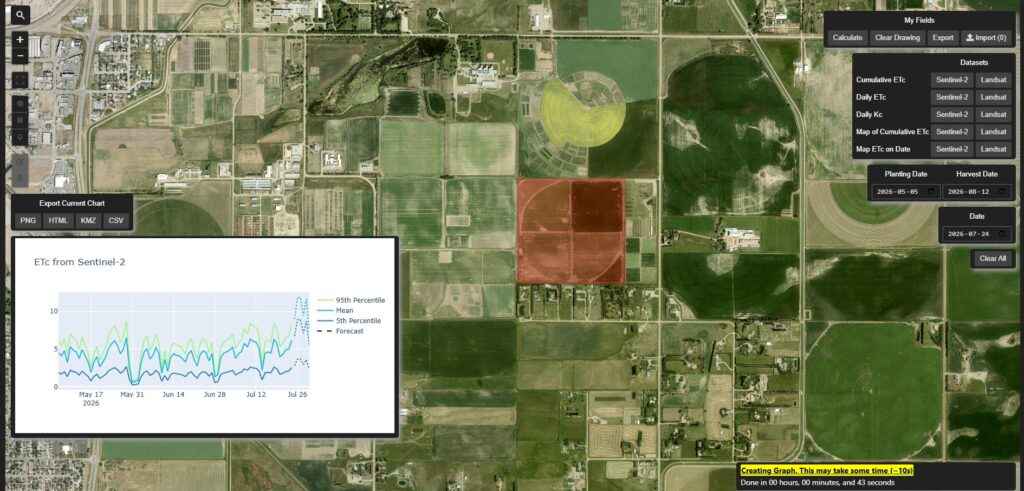
The tool is also intended to feed into MIRG’s broader research program. Kehoe says ET information can be combined with other data to develop tools that help optimize crop inputs and reduce the risk of yield losses.
“One of the exciting benefits of Irrimap is that it is feeding into other tools we’re researching and developing, like crop input optimization tools,” he says. “Projects like these ensure data-backed decisions are made that better manage inputs to minimize risks to yield.”
The development of Irrimap also illustrates the role of students in MIRG’s applied research. Derian Setoguchi, who graduated from Lethbridge Polytechnic’s Computer Information Technology program in 2025, initially joined the group as an intern. He is now a research assistant and developed the program’s code using skills gained through his studies.
“Irrimap was my first big project with technologies that I was unfamiliar with,” Setoguchi says. “I was able to apply a lot of what I learned in CIT to work through the problems I encountered, like optimizing code and understanding the math behind the project.”
Building a broader irrigation research hub
The launch comes days after RDAR announced its $500,000 contribution to support Appels as she develops MIRG into a hub for applied irrigation research.
The funding, provided through the Canadian and Alberta governments under Sustainable CAP, is intended to build on MIRG’s work in controlled trials, technology validation and industry-engaged research.
The research will address practical issues including irrigation decision-support tools, the economic and regional effects of irrigation choices and sustainable crop production. The group plans to continue working with producers, commodity organizations, irrigation districts and industry partners.
RDAR CEO Dr. Mark Redmond said the need to connect different sources of information is becoming increasingly important as technologies such as soil sensors, weather monitoring and irrigation systems generate more data.
“Water is one of the defining issues for Alberta’s future, and applied irrigation research is essential to helping producers make decisions that improve water use, protect productivity, and support long-term resilience on their farms,” he said.
That broader approach reflects the direction of Appels’ work, which focuses on water-use efficiency and the interaction between irrigation and agronomic practices. She said the goal is not simply to collect more data, but to turn it into information that can be applied at the field and farm level.







 Facebook
 Twitter
 Instagram
 LinkedIn
 YouTube