

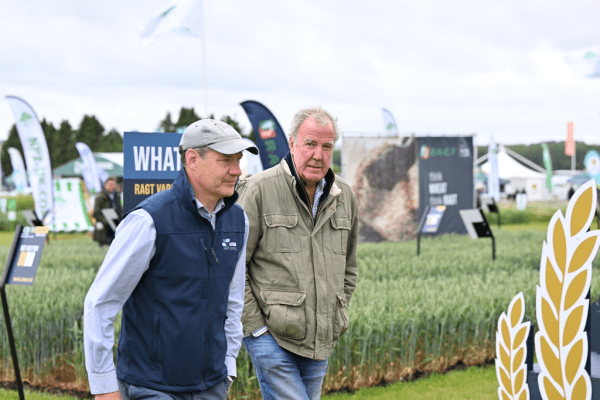
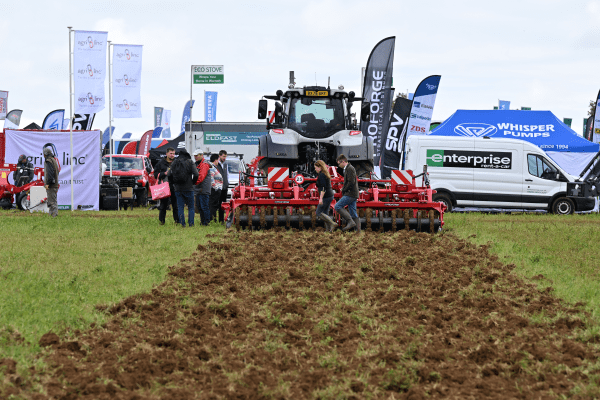
Cereals 2026, the leading arable show in the UK, descended on Diddly Squat Farm in Gloucestershire, UK, at the start of June. The farm appears in the TV programme Clarkson’s Farm, and the celebrity allure brought in the visitors, more than 25,000 of them, and exhibitors, more than 700 stands for the two-day event, which also included demonstration arenas, trial plots, and panel discussions on various stages across the site.
Reflecting on the event, Jeremy Clarkson said: “Cereals has ended and what a thing it’s been. I’ve loved every minute and it was a delight to see so many people turn up… My profound thanks to everyone involved. It was an absolute honour for us all at Diddly Squat to be chosen as the host.”
Before the event, Ceres Rural managing partner Charlie Ireland, who appears in the TV show, said: “Cereals has always been where farmers come to find practical answers, and this year’s agenda reflects the scale of the decisions facing the industry.”
This leads to take-away number one.
1) More biological companies exhibiting
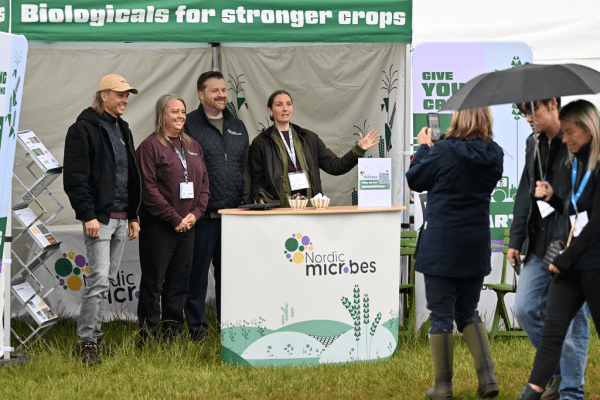
There were several biological input companies exhibiting that would be known to attendees of New AG International events. This would suggest the UK market has opportunities, or at least farmers are waking up to the potential. There were big names such as Corteva Agriscience, Syngenta, Bayer, Timac Agro, Fertinagro, Yara, Rovensa Next and De Sangosse. Azotic Technologies, well known to readers of New AG International and active in the US market, has a distribution agreement for its nitrogen-fixation product Encera with the distributor ProCam UK. There was a new kid on the block in the form of Nordic Microbes, which has a biostimulant seed treatment.
2) UK agtech and bio research activity on the rise
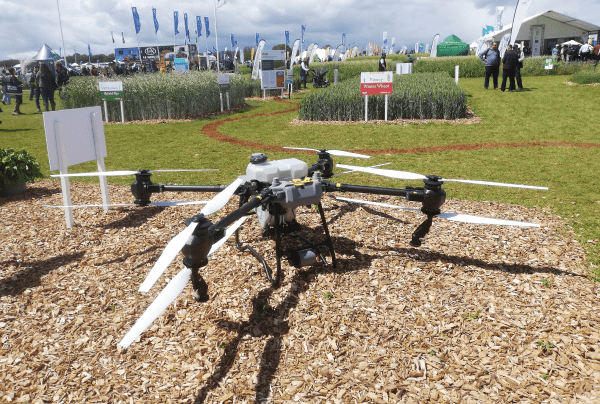
This might surprise given there are relatively few manufacturing companies in the bio-input space – although slightly more in the R&D and start-up area. At an Agrii press briefing, the company said it had conducted research trials on around 60 biological products so far, with more planned. The company is also looking at the delivery of biologicals using drones.
The Indian company Zydex came to Cereals looking to partner with farmers who were willing to conduct trials using its product Synergy-M. More here.
Megha Lohia, Director of Business Development, Zydex – the Indian conglomerate that started in asphalt and has moved to many new areas, such as bio polymers and their applications. The company’s agricultural unit, headed by Lohia, came to Cereals looking for farmers to trial a biofertilizer product called Synergy-M, which the company says improves the physical structure of soil allowing better water distribution. Lohia explained that the company wants to test the product in UK soils and conditions. Synergy-M is in a hard granule formulation and combines biodegradable polymer with microorganisms and humates.
Although not exhibiting at Cereals, the John Innes Centre is developing a centre, along with The Sainsbury Laboratory, which aims to be a world-class plant and microbial research hub. Winning approval in March of this year, the main laboratory building (MLB) will provide approximately 12,000 m² of laboratory area, at the heart of the Norwich Research Park, and construction is scheduled to begin in 2028.
3 – UK farming woes: farmers are looking for solutions
The third take-away reiterates Charlie Ireland’s opening comment – farmers come to Cereals looking for solutions. One liquid fertilizer company told New AG International that they had received much interest in switching from solid fertilizer to a liquid system. This interest was a combination of nutrient efficiency and fertigating benefits, as well as building resilience from supply chain issues with solid fertilizer.
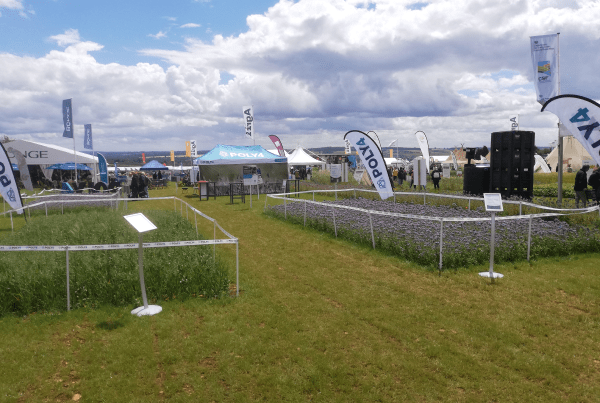
Anglo American was at the event demonstrating its Poly4 product. The company is currently building a new mine, the Woodsmith project, on the coast of North Yorkshire. The polyhalite for its Poly4 product is currently coming from ICL’s Boulby mine which is 50 km north of Anglo American’s project. The polyhalite seam runs under the North Sea.
4 – Organo mineral fertilizers offer buffer to conventional fertilizers
Also present at Cereals were products in the organo-mineral segment. These sources of nutrients could offer some buffer from the problems of reduced supply of conventional fertilizers, such as the recent restriction from the Strait of Hormuz.
From Northern Ireland, SoilWorx brought among its samples a 4-2-3 fertilizer derived from poultry manure. It also has a high nitrogen version based on organic nitrogen sources, as well as a high potassium product. Dr Paul O’Hora, Sales Director, told New AG International that the company’s products offered a route to increasing circularity in the economy. He also mentioned the soil health benefits of these products, which leads to the next takeaway…
5 – Focus on soil health
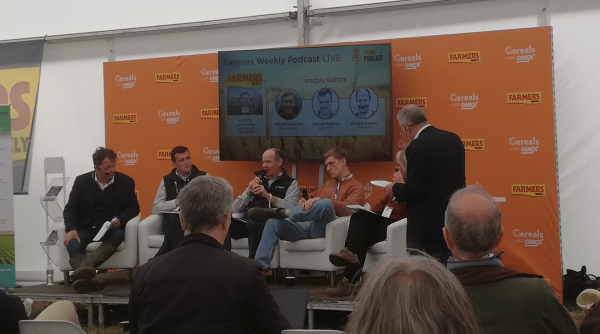
The programme included various talks on regenerative agriculture. One panel looked at how to integrate livestock with arable rotations and build soil health before then discussing how biologicals in modern farming could help to cut input costs.
Letty Glaister, Head of the Agricultural, Rural and Estates team at Tees Law, was quoted in the event press release: “As the agricultural landscape shifts away from traditional support structures, the importance of robust, forward-thinking business models cannot be overstated.
“Our role is to help farmers navigate the legal complexities of these transitions and that’s why we partner with BASE-UK and Cereals. The ‘Growing Without Government Support’ theme is important and we hope this will help farmers to secure their legacies and livelihoods in this new era of independence.”
Also, on the theme of soil health there was a British Biochar Pavilion. There were demonstration plots from Carbon Hill using its biochar amended manure.
Carbon Hill is a family-run operation based in mid-Wales producing biochar from locally sourced, underutilized biomass such as hedgerow trimmings and green waste. The company uses proprietary low-emission pyrolysis systems developed in-house and deployed by other producers in the UK and Sweden.
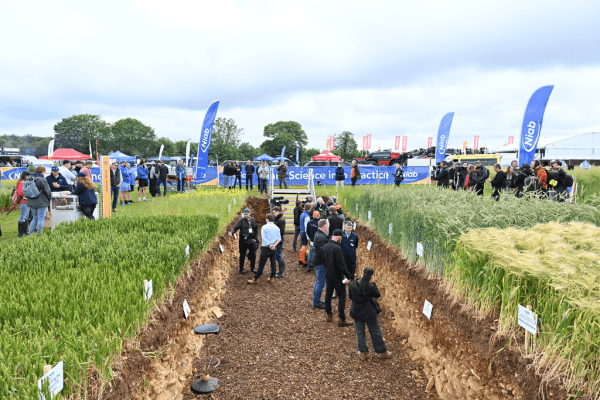
Near to one of the entrances to Cereals was the National Institute of Agricultural Botany (NIAB) Soil Hole. The NIAB Soil Hole offered visitors the opportunity to stand 1.8m below the surface and observe the stony soil, known locally as Cotswold Brash, below Clarkson’s estate. The 20-metre-long exhibit gave farmers the chance to see how crop roots integrate into a shallow, stony soil profile, and vary under different fertilizer programmes. NIAB was showcasing over 25 crop species across 130 plots, covering variety choice, crop protection, nutrition, and soil management.
These five takeaways are from a New AG International perspective and reflect the summarising words of Diddly Squat adviser and Ceres Rural managing partner Charlie Ireland: “What really stood out was the mood among farmers. Yes, there are still huge pressures across the industry, but Cereals showed just how determined, practical and forward-looking British farming is.”









 Facebook
 Twitter
 Instagram
 LinkedIn
 YouTube