

A close look at exciting irrigation studies on several species, but also how halophytes fit into the picture.
By Treena Hein
As world population rises, demand for water grows and droughts become more common, the need to boost crop production through innovative approaches is clear.
Indeed, according to the International Center for Biosaline Agriculture (ICBA) in the United Arab Emirates, about 25 percent of the world’s arable land is impacted by salinity. In many parts of the world, approaches include irrigating with saline water, using crops that are being developed not just to tolerate this but to thrive.
Alfalfa is of particular interest for this purpose, in California. “The dairies need alfalfa to be grown here as it’s too bulky and expensive to ship it from other states,” explains Dr. Devinder Sandhu, a research geneticist in the Agricultural Water Efficiency & Salinity Research Unit at the USDA (U.S. Department of Agriculture) U.S. Salinity Laboratory in Riverside, California. However, Sandhu explains that “we want to grow alfalfa where the soil is too saline for almonds [which is a very high-value crop]. There are parts of many other U.S. states where saline soil is an issue, including Virginia, Arizona, Utah, New Mexico, Colorado, Nebraska, Wyoming and Idaho.”
Sandhu and his colleagues started with a very large alfalfa germplasm collection. “Using traditional breeding, we have screened over 2,700 lines and we see a mixture of several mechanisms of salt tolerance,” he reports. “There is the mechanism of exclusion of sodium from roots into the soil. Root cells also place excess sodium ions in vacuoles, rendering them harmless to the cytoplasm of the cell. We also see sodium ions being regulated in the xylem transpiration pathway where they are sent back down to the root.”
There is also the situation where, if sodium makes it to the leaves, there are variations in tolerance to this within the leaf tissues, Sandhu notes. He adds, “some of these mechanisms are more active in some lines than others and they are found in other plants as well. In some plants, chloride (Cl) is the more important ion, not sodium (Na).”
The team has narrowed germplasm down to 12 lines. Further evaluation in trials with water at various salinity levels revealed two lines that produced equivalent biomass (to plants receiving normal water) under salinity levels equivalent to 1/3 seawater. Then astonishingly, after further breeding with tests with water with higher and higher salt levels, alfalfa lines were created that can survive using actual seawater from the Pacific Ocean.
But crop research at the U.S. salinity lab goes well beyond alfalfa, to 15 other species spanning vegetables, fruit trees and nut trees. Looking at specific salt-tolerance mechanisms – and while a species may display several salt-tolerance mechanisms, one generally stands out – Sandhu explains that in almond trees, Na and Cl exclusion is the main process. In strawberries, it’s so far been found that they contain a lot of chloride in roots, when irrigated with saline water, but not leaves. Alfalfa and spinach treated with salty water both have high tissue tolerance to Na and Cl. But Sandhu explains that “these plants can tolerate it to a level that is still fine for humans in the case of spinach, and fine for cows in alfalfa. Cows don’t get enough sodium in their diets and that’s why salt licks are used.”
From a breeding and genetics perspective, the focus is on the genes related to the mechanism that plays the most important role. “We have identified, for example, three genes in alfalfa related to exclusion of salt in the water absorption of root cells,” Sandhu reports. “We have put them in [the model plant] Arabidopsis to confirm this, and we will be putting them into a salt-sensitive line. These genes should also be able to be engineered in spinach and other crops.”
With alfalfa, they are also focused on producing seeds of the lines that can survive seawater salinity, “for broader testing and potential distribution within the next year or two,” Sandhu adds.
Why drip irrigation matters
Across the Pacific Ocean, using saline water for irrigation has also been under investigation at the Department of Primary Industries and Regional Development (DPIRD) in Western Australia. While a significant amount of better-quality water in the region – the Swan Coastal Plain – is already allocated for irrigation and other water users, there are large volumes of marginally-saline water available for irrigation.
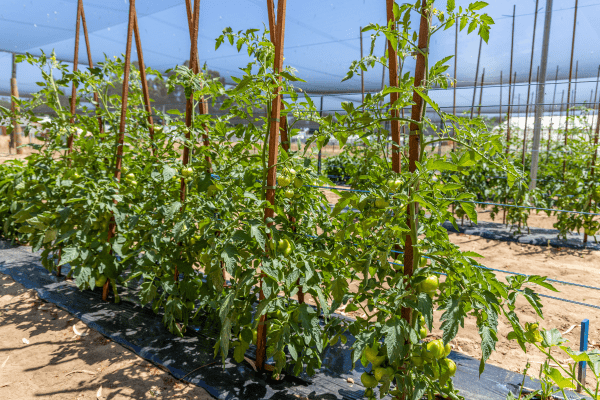
At DPIRD’s South Perth research facility, trials have been carried out on tomato and rockmelon in coarse sandy soils with plastic sheeting used to reduce evaporation. The two-year study, which has been submitted for journal publication, included a look at optimal irrigation frequency, soil moisture levels and evaporation rates, time of year and crop growth stage.
Type of irrigation was not a factor in the study, however. Dr. Lukasz Kotula, who led the DPIRD study but is currently a dual research fellow in the School of Biological Sciences and the Institute of Agriculture at the University of Western Australia, explains that when using saline water for irrigation, drip irrigation is key.
Find out the results with tomato and read the full article from our SEP/OCT 2025 issue of New AG International. The theme of this issue was Water with editorial covering products that reduce water usage in irrigation and combat water stress in crops.








 Facebook
 Twitter
 Instagram
 LinkedIn
 YouTube