

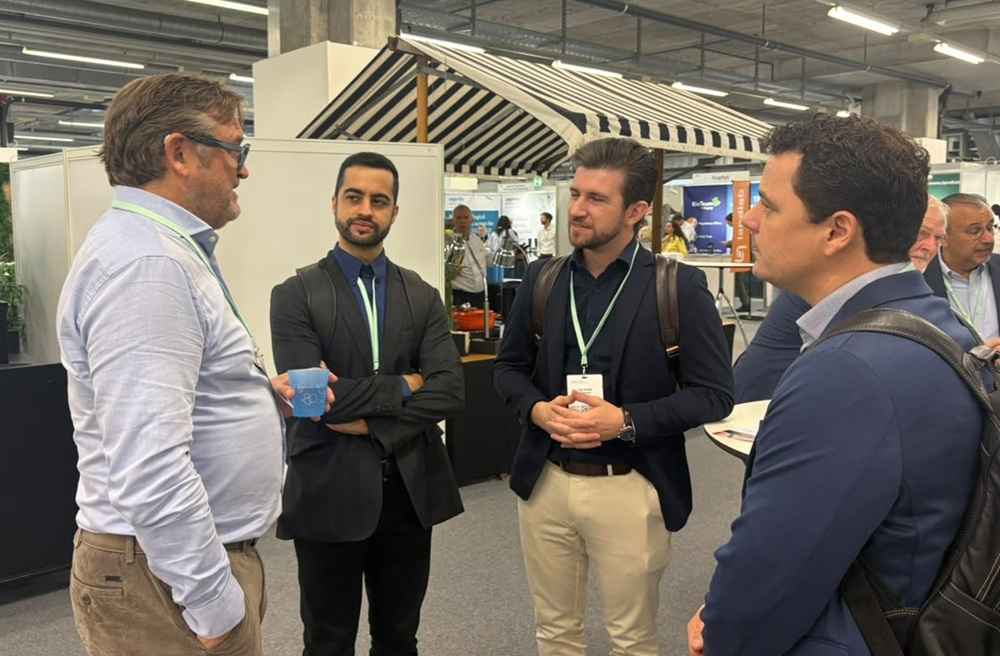
Brazil demonstrated its leadership in the development, production and application of biological crop protection products at ABIM 2026 (Annual Biocontrol Industry Meeting), held in Basel, Switzerland, 20-22 October. With a rapidly expanding market, a strong track record in applied research and companies investing in technology and internationalization, Brazil positioned itself as a global reference in biocontrol, attracting interest from distributors and potential business partners across different regions.
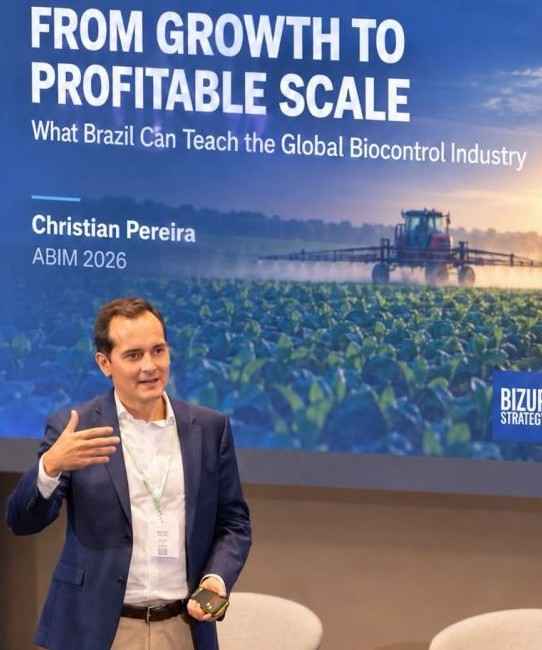
According to Christian Pereira, agribusiness strategist at Bizup Strategy, biocontrol products are now used across 52 percent of Brazil’s monitored cultivated area, up from approximately 30 percent just a few years ago, according to Kynetec Brasil data. In a presentation at the event, Pereira identified four key factors behind this growth: intensive tropical agriculture, limitations in certain chemical crop protection solutions, the regulatory environment and decades of applied research.
In Brazil, the possibility of growing two crops a year — and, in some regions, three — increases pest and disease pressure while allowing farmers to test and refine technologies under real-world field conditions. At the same time, challenges such as nematodes, caterpillars and fungicide resistance have created opportunities for biological alternatives.
Pereira also highlighted the impact of regulation on the pace of innovation. According to estimates he presented, the registration of biocontrol products can take one to two years in Brazil, compared with as long as 10 years in Europe.
However, Brazil’s experience extends beyond its agricultural conditions. Universities, Embrapa, research institutes and companies have helped turn scientific knowledge into commercially viable technologies. Pereira said the next challenge is to translate rapid market growth into sustainable profitability as competition intensifies, product portfolios expand and pressure to differentiate increases.
Renera boosts Brazil’s international profile
Brazil’s presence at ABIM 2026 was further strengthened by the Renera (Brazilian Bioinputs Hub) exhibition stand, an initiative led by CropLife Brasil in partnership with ApexBrasil, Brazil’s trade and investment promotion agency. The project aims to raise the international profile of the country’s biological inputs industry, foster strategic connections and create opportunities for business development, and scientific and technological cooperation.
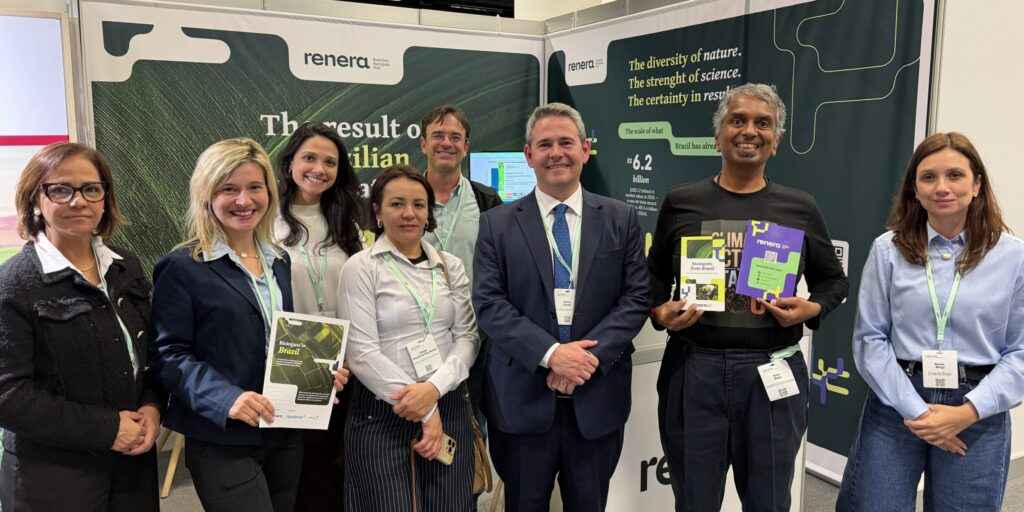
For Renata Meliga, the hub’s manager, participation in the event represents a step forward in positioning Brazil on the global stage.
“Taking part in this event expands business opportunities, strengthens strategic connections and consolidates Brazil’s position as a global benchmark in biological inputs,” she said.
The stand also featured Amália Borsari, director of CropLife Brasil, and Julia Pupe, the organization’s regulatory and institutional manager for biological inputs. The initiative sought to showcase Brazil’s scientific and industrial capabilities, its biodiversity as a source of innovation, and the international competitiveness of its domestic companies.
Cogny Ecosystem targets 30 countries by 2030
Among the Brazilian companies attending ABIM 2026, Cogny Ecosystem stood out for its international expansion strategy and investment in research, development and industrial capacity.
Felipe Fiorese, Cogny’s international business manager, said the company’s participation in ABIM 2026 included meetings with prospective distributors and business partners, particularly in the European Union and North Africa. The group’s goal is to establish a commercial presence in 30 countries by 2030. It currently exports directly or indirectly to 15 markets through its own brands and business-to-business (B2B) supply arrangements.
Tulio Silva, also an international business manager at Cogny, emphasized the competitiveness of Brazil’s biologicals industry amid the growing presence of Asian manufacturers. He said discussions at the event reinforced his view that Cogny Ecosystem is keeping pace with the world’s leading innovators.
“In no respect is Cogny Ecosystem behind any company in the biologicals industry today,” Silva said, citing technology, industrial capacity and workforce expertise.
The group’s growth strategy also relies on technical support for farmers. Derik Chamberlain, Bioma‘s executive commercial director, said the ecosystem has more than 300 field technicians and plans to expand that workforce by approximately 30 percent, reaching around 400 professionals in 2027.
For Chamberlain, combining skilled personnel, technological leadership and practical demonstrations of product performance is essential to sustaining the group’s expansion.
Brazil’s participation in ABIM 2026 thus highlighted a new phase for the country’s biologicals industry. Beyond expanding domestic adoption, Brazilian companies are seeking to leverage their agricultural expertise, innovation capabilities and production scale to strengthen their international competitiveness.











 Facebook
 Twitter
 Instagram
 LinkedIn
 YouTube