

By Janet Kanters
In the face of increasing drought and water shortages, an innovative new research project is tapping into the power of nature to help Canadian dairy farmers treat wastewater and reuse it for crop irrigation.
Led by Dr. Audrey Murray, a research scientist with Agriculture and Agri-Food Canada (AAFC), the five-year initiative aims to harness constructed wetlands as a natural treatment system for dairy farm wastewater. The project is a collaboration between researchers from Prince Edward Island, Alberta, and Ontario, and is funded by Alberta Innovates and Results Driven Agricultural Research.
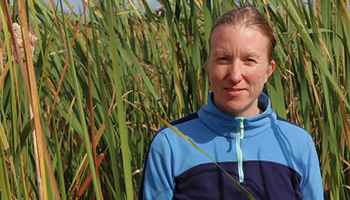
“I’ve always had an interest in water reuse,” says Dr. Murray. “Water is a limited resource and drought conditions in Alberta have increased the need to improve water use efficiency. Certain natural climate solutions can provide many ecosystem benefits like high-quality water.”
Turning waste into water
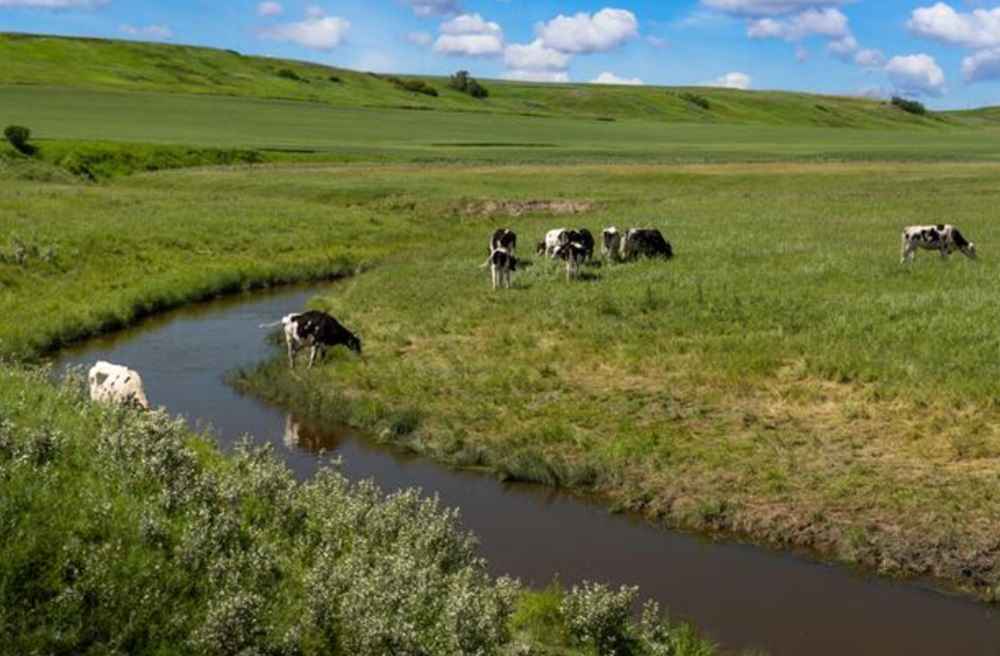
Dairy farms in southern Alberta rely heavily on water to irrigate feed crops, support cattle, and maintain household needs. But with water increasingly scarce, farmers are often forced to prioritize livestock over crops.
At the same time, these farms generate significant amounts of wastewater – from milk house rinsing water and used bedding straw to manure – all of which is stored in holding lagoons. Currently, this wastewater is mixed into a slurry each spring and applied to fields as fertilizer. But Dr. Murray’s team sees another opportunity: treat the water within the lagoons and reuse it throughout the growing season.
The solution? Constructed wetlands, paired with mixing ponds, to naturally filter and polish the wastewater before it’s reused for irrigation.
The science of separation
Over time, wastewater in lagoons separates into layers – much like cream in milk. The middle layer, which contains the cleanest liquid, can be piped downhill into a constructed wetland, where it undergoes natural treatment. This method mimics common designs in municipal wastewater systems, using gravity to move the water and wetland plants to help clean it.
After passing through the wetland, the water enters a mixing pond where it’s blended with clean water to ensure it meets quality standards for irrigation.
“The ideal scenario is to build a wetland sightly downhill from the holding lagoon,” notes Murray. “A pipe is placed into the right location of the holding lagoon, connecting it to the wetland, and then gravity does the rest. This engineering solution is very common in municipal wastewater treatment plants.”
This approach improves with each stage of treatment, she adds. The lagoon settles solids, the wetland filters and biologically treats the water, and the mixing pond provides the final polish.
Simulating nature in miniature
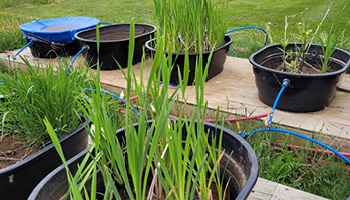
Before applying the system on a full-scale Alberta farm, Dr. Murray is testing her hypothesis on a smaller scale at the Harrington Research Farm in Prince Edward Island. There, she’s building a series of mesocosms – outdoor experimental setups that replicate wetland conditions using wastewater from local dairy farms.
Each mesocosm uses different wetland materials, like various soils and plants, to determine the most effective design for treating wastewater. Results from these tests will guide the final system layout, treatment time, and cost estimates for a full-scale implementation.
Looking ahead
The team is currently seeking a volunteer dairy farm in Alberta to host the full-scale pilot. If successful, the system could become a cost-effective and environmentally friendly way for dairy farms across Canada to address water scarcity and wastewater management.
In the long run, Dr. Murray hopes this nature-based system will help dairy producers not only reuse water but also contribute to broader climate goals – by enhancing biodiversity, improving soil health, and even sequestering carbon.
Key Takeaways:
• Drought response: As water shortages become more common, researchers are developing a system to recycle dairy wastewater for crop irrigation.
• Natural treatment: The system uses gravity, wetlands, and mixing ponds to clean wastewater naturally.
• On-farm application: A scaled-down model is currently being tested in PEI, with plans to implement a full system on an Alberta dairy farm.
• Ecosystem benefits: The approach supports water conservation, carbon capture, and biodiversity.
The upcoming September/October issue of New AG International has the theme ‘Water as an agricultural resource’. To advertise in this issue, contact us here.










 Facebook
 Twitter
 Instagram
 LinkedIn
 YouTube