


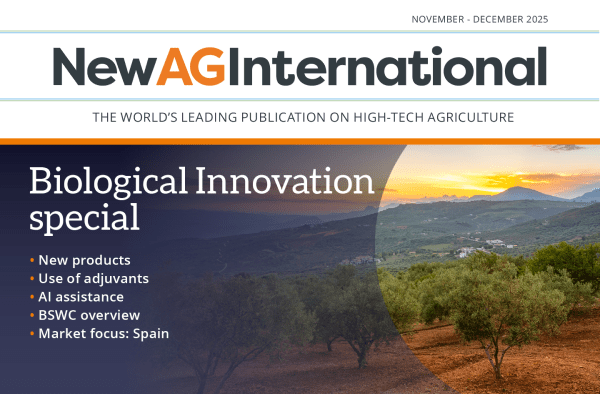
Welcome to the November/December 2025 issue of New AG International. The theme was Biological Innovation – a wonderful appetiser for the Biostimulants World Congress which took place in Barcelona, 1-4 December. In this issue, we took a deep dive into the fast-evolving world of biological innovation in agriculture. How is the world’s largest retailer approaching this sector and making room on its shelves for bio products? And what of the role of bio adjuvants – bio-inputs need these vital helpers. We also examine how artificial intelligence is transforming biological product development – accelerating R&D cycles, boosting efficacy, and enhancing the commercial viability of biologicals for both developers and farmers. These themes, along with broader insights into the future of sustainable inputs, set the stage for an issue rich in forward-looking perspectives. Plus, the Bernard Blum awards reach their 10th year, and one irrigation company launches its solution to one of the most persistent challenges in centre-pivot irrigation: uneven water distribution at the outer ends of pivots.
Dive into the issue here, or read our rundown and follow the links.
BIOSTIMULANTS
Rooted in biology – Nutrien Ag Solutions and Loveland Products lead the next wave of biological innovation
Loveland Products, the proprietary input business of Nutrien Ag Solutions, is investing heavily in next-generation biological and biostimulant technologies. New AG International speaks to Ron Calhoun, senior marketing manager of plant nutrition at Loveland Products. Here
By Janet Kanters
8th Biostimulants World Congress – Programme Overview
At the beginning of December, the Biostimulants World Congress returns to Barcelona for its 8th edition. More than 1,300+ attendees will descend on BCN in the almost certain knowledge they will get ROI, whether it’s from the scientific or commercial tracks. Let’s have a detailed look at the programme. Exhibitor listing here.
Firing on all Cylinders
French company Cybèle Agrocare is using fermentation to produce microbial biostimulants that power up crops to become more resilient to drought. Here
Adrian Lautrey, PhD, innovation and agronomy project manager and Nina Vinot, Business development director explain.
Bioiberica releases white paper on the use of Amino Acids in Agriculture
Bioiberica has a released a free-to-download white paper on “Use of Amino Acids in Agriculture – How to mitigate abiotic stress and increase yields”. This comprehensive report examines the rapidly evolving biostimulants market and Bioiberica’s cutting-edge solutions for modern agricultural challenges. The document provides an in-depth analysis of market dynamics, sustainability imperatives, and the scientific foundation behind amino acid-based biostimulants.
PLANT PROTECTION
Take Ten
The Bernard Blum Awards reached a milestone this year – 10 years of recognizing the best in biocontrol innovation. New AG International was there at the beginning, working with the IBMA to launch the awards in 2015. Here
Evolution of adjuvants
As the bioproducts markets grow, so is the market for enhancement additives. Here’s a look at the progress so far and what’s to come. Here
By Treena Hein
From lab to field – what can AI bring to biological product development?
Artificial intelligence (AI) is already assisting microbial bioprospecting, by rapidly identifying effective strains and improving the design of targeted biological solutions. By cutting time, cost, and trial-and-error, AI is helping the biologicals industry overcome long-standing challenges and drive the next wave of sustainable agricultural innovation. here By Lindi Botha
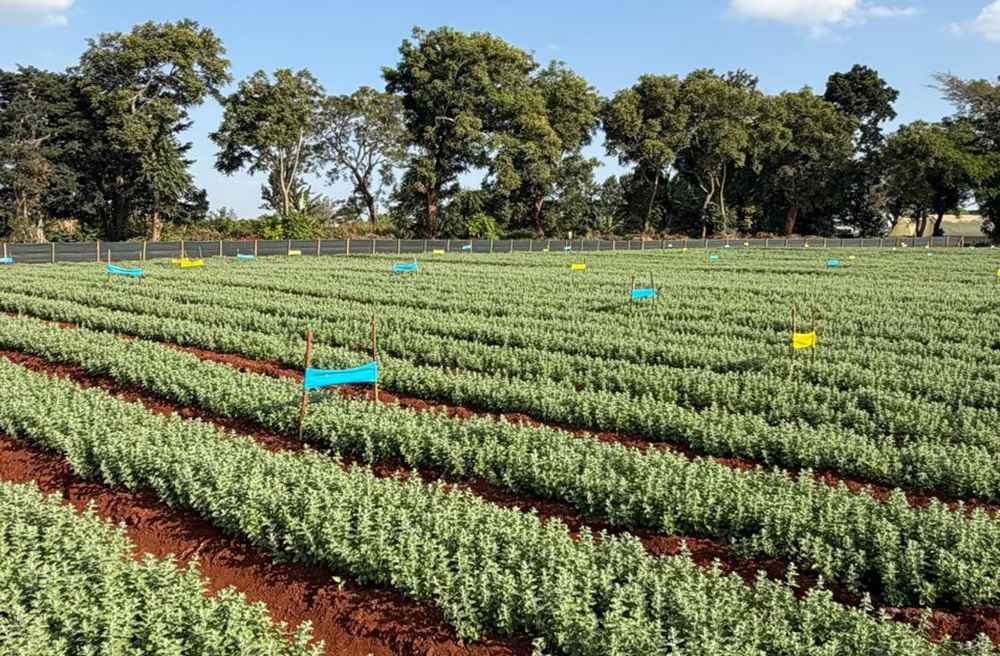
Early farmer engagement drivers stronger support for biological pest control in Kenya, study shows. Here
LEADER PROFILE
From seaweed to bio-intelligence: How Trishul Biotech’s UpCrop platform is pioneering climate-resilient bio-inputs. Trishul Biotech deliberately based its operations in southern Tamil Nadu, close to the biodiverse coastal region near Tuticorin. These waters host abundant red and brown seaweeds such as Gracilaria sp., Kappaphycus sp., and Sargassum sp. Founded in 2017 in India, the company has become a model for how marine and plant biochemistry can be transformed into what its founders call bio-intelligence – the next generation of climate-resilient, compliant biological inputs. here
PRODUCTS AND TRENDS
India, Southeast Asia, and Africa shifting biofuels into high gear
Maize, sugar cane, and oil palm cultivation is accelerating, but can these regions expand fast enough?
By Prof. Michael Tanchum. Here
The regions of South Asia, Southeast Asia, and Africa are experiencing strong population growth, with the resulting increase in demand for both food and higher protein diets. Consumption trends for maize, sugar cane and palm oil are set to increase leading to competing demands for growing crops for animal feed versus crops for biofuel production.
In India, increased production of sugarcane and wheat is driven by ethanol mandate for fuel. India’s agricultural sector is on track to outpace the growth of India’s manufacturing sector thanks partly to the growth in corn production for biofuels. Despite being the world’s fifth largest maize producer, India has become a net importer of maize, partly to meet the country’s E-20 mandate, using 20% ethanol blend in gasoline by 2026. The total land area under maize cultivation has increased by 17% over the past 5 years. The use of maize for ethanol was intended to relieve pressure on sugar cane. Here is where the sugar cane dynamic brings in other countries in Southeast Asia. Read the full article here for an excellent summary of where commodity and demographic dynamics provide opportunities for agri inputs.
Reshaping the definition of plant nutrition via chelates
ICL discusses the development of a new biodegradable chelate – which delivers nutrients to plant cells and is challenging farmers and growers to move beyond the traditional mindset in agronomy.
“Chelates are the invisible couriers of micronutrients like zinc, manganese, copper and iron. They keep metals soluble and mobile so plants can absorb them.” Here
Sustainable farming under the Nitrate Directive and Farm to Fork program
BTU gives its perspective on how farmers can navigate the competing requirements for high yields with more environmental obligations and the tools that are there to help them. Here
Biostimulants Farmer’s Award: Highlighting innovation in sustainable agriculture
The Biostimulants Farmer’s Award returns to the Biostimulant World Congress, and highlights agricultural innovators who are transforming modern farming through the strategic use of plant biostimulants. Sponsored by Syngenta Biologicals. here
The future of water – Aqualatus?
Engage Crop Solutions, a UK-based agri-tech innovator, has developed a unique water-saving technology, Aqualatus™ that enables growers to reduce irrigated water use by 50%, while maintaining crop yields. This means more crops can be grown with less water, offering a vital solution to the global problem of water scarcity and an increasing demand for food production. This product is already available on global markets, under the name Integrate. here
IRRIGATION
Irrigation technology development and adoption challenges
Irrigation technology has transformed commercial agriculture by enabling farmers to grow crops more reliably, particularly in regions prone to drought and unpredictable rainfall. Over the past century, irrigation systems have become essential tools for enhancing agricultural productivity and ensuring food security. By Renata Rimšaitė, PhD here
Komet launches Precision Wave to redefine pivot irrigation uniformity
Komet Irrigation has introduced the Komet Precision Wave (KPW), a new-generation end-of-system sprinkler designed to solve one of the most persistent challenges in centre-pivot irrigation: uneven water distribution at the outer ends of pivots. here
Can Vertical Farms truly go green?
New Study questions the carbon cost of a ‘sustainable’ food revolution. Here
By Janet Kanters
“…a new study from the University of Surrey, UK, is challenging that assumption. The research, published in Food and Energy Security, has found that while vertical farms can out-yield traditional lettuce farms more than twentyfold and use vastly less water, they still carry a heavier carbon footprint.”
REGIONAL REPORT
Spain – a driver for biostimulant adoption
The growing use of biostimulants in Spanish agriculture is driven by a combination of regulatory, environmental, economic, and technological factors. By Dr. Oded Achilea
“According to AEFA (Spanish Association of Agro-Nutrients Manufacturers), biostimulants featured 20.7% of Spanish agro-nutrient market value in 2023, (AEFA, 2024).” Here
+++












 Facebook
 Twitter
 Instagram
 LinkedIn
 YouTube