


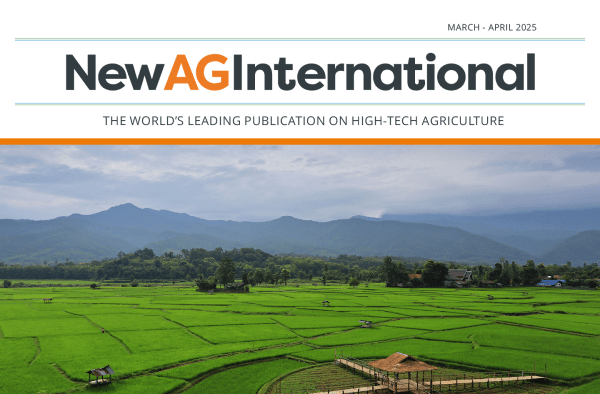
The theme for the March/April 2025 issue of New AG International was simply ‘Soil’ – the health of soils is rising up the agenda as many parts of the world struggle to protect this most valuable of agronomic assets. We come at it from various angles – the impact of biostimulants on soil, the use of biocontrol in soil, soil monitoring technology, the different irrigation for soil types. Plus other features, and a trip to Taiwan. Dive in, we’re confident you’ll find something of interest.
Overview: Soil is often regarded as nothing more than dirt, something to be tilled, plowed and forgotten once crops are sown. Indeed, soil has been largely overlooked, and yet it is a crucial tool in cropping systems worldwide.
These days, inputs in the soil biome are also being investigated to determine if they alter and/or add to the positive properties of various soils. In our Biostimulants section, we have a story by Treena Hein that cites a research paper in which scientists focused on 10 studies involving both lab and field investigations into the effects and modes of action of common, non-microbial biostimulants within the soil matrix.
In our Plant Protection section, we bring you a feature by Lindi Botha that investigates soil-applied biocontrols – which are proving to be a powerful tool in crop production. Biocontrols applied in the soil are proving to be particularly adept as these beneficial organisms stop pests before they can create problems above ground, writes Botha. This proactive approach not only improves plant health from the outset but also reduces the need for chemical interventions later in the season.
Focus on Southeast Asia
New AG International was in Thailand in May 2025 for our 23rd Annual conference – “Revolutionizing Agriculture: Cutting-Edge Specialty Fertilizers and Bio Ag Innovations in Asia”. To gain some insight into the Southeast Asia region, we have a piece by Professor Michael Tanchum. The demographic trends in the region will create a wealth of opportunities for agribusiness, combined with the drive towards agri-food self-sufficiency. Indeed, as Michael writes, the famed ‘tiger economies’ of Southeast Asia were quiet during the pandemic but are now on the prowl again.
Site visits
This issue also contained to two site visits by New AG International – the first to feature was to the opening of Tessenderlo Kerley’s new Thio-Sul plant within the Chemelot complex in Geleen, Netherlands. The 130,000 t/y ammonium thiosulphate (ATS) plant is Tessenderlo Kerley’s third European production site for its ATS product Thio-Sul.
‘Made in Taiwan’ is an international phrase, more commonly associated with microchips than biologicals. But the latest to roll off the manufacturing line is precision-orientated peptides. New AG International began the year with a visit to the R&D and production facilities of CH Biotech in Taiwan.
Going back to the theme of soil – what does this mean for irrigation? We explored how soil type dictates watering rates and intervals. We learned that understanding different soil zones and their varying water-holding capacities is crucial for effective irrigation management.
Online shopping has become commonplace but what about water-soluble fertilizers. We spoke with Waypoint Commodities – a company that has developed its own digital procurement platform specializing in water-soluble fertilizers.
Links are provided below for these features and many more features. But you can open the issue here – for FREE, no sign-up needed !
Here’s a rundown of the features from this issue:
Changes to the soil
Biostimulants impact the soil and its microbe community, but more research is needed for product development and to back up claims. Treena Hein writes.
As those in the biostimulant community are well aware, there has been an explosion of scientific research into these substances in recent years. Most of it, however, has been focused on the direct effects of various active ingredients on plant physiology, while the surrounding soil support system has largely been ignored.
Featuring: Dr. Jane Rickson, Cranfield University
The soil bound bullies you want in your biocontrol arsenal
Biocontrols applied in the soil are proving to be particularly adept as these beneficial organisms stop pests before they can create problems above ground. Lindi Botha writes.
• “If the first-contact fungi are those that are beneficial, like Trichoderma, then the seed is bolstered and able to fight against pathogenic fungi that it might later encounter.” Dr. Johan van der Waals, technical manager at Real IPM in South Africa.
• Entomopathogenic nematodes (EPN) are generally applied in winter to target insects that hibernate or lay their eggs in the soil. “Applications should therefore be timed according to the lifecycle of the pest, to prevent the next generation from emerging.” Prof. Antoinette Malan, entomologist, Stellenbosch University.
Featuring
Dr. Johan van der Waals, Prof. Antoinette Malan, Shabeg Briar, Canola Council of Canada, The Canola Research Hub
Technological advancements in soil health monitoring and management
In recent years, technological innovations have revolutionized our approach to understanding and managing soil health. Traditional methods of soil assessment have given way to sophisticated, data-driven technologies that provide unprecedented insights into soil conditions. Read here by University of Nebraska-Lincoln.
Topcon: Enabling breakthroughs in agricultural productivity
Topcon Positioning Systems is a designer, manufacturer and distributor of precision measurement and workflow solutions for the global agriculture, construction and geospatial markets. An interview with Antonio Marzia, Executive Vice President and General Manager at Topcon Agriculture.
Tessenderlo Kerley opens new Thio-Sul plant, receives double inhibitor registration
Tessenderlo Kerley has ramped up production at its newly constructed Thio-Sul plant within the Chemelot complex in Geleen, Netherlands. The 130,000 t/y ammonium thiosulphate (ATS) plant is Tessenderlo Kerley’s third European production site for its ATS product Thio-Sul. New AG International was invited to the company’s conference and site visit for customers and stakeholders.
Move over K-pop, time for T-pop
‘Made in Taiwan’ is an international phrase, more commonly associated with microchips than biologicals. But the latest to roll off the manufacturing line is precision-orientated peptides (POP). New AG International began the year with a visit to the R&D and production facilities of CH Biotech in Taiwan.
Restoring soils with biologicals
The war in Ukraine has resulted in extensive soil degradation due to explosions, heavy metal contamination, and hydrocarbon pollution. BTU has developed a comprehensive bioremediation strategy to restore these damaged soils. Studies conducted on war-affected soils show that after 90 days of applying Ecostern Detox, microbial communities in contaminated areas began to recover, approaching natural soil conditions. Read here.
Optimizing irrigation: How soil type dictates watering rates and intervals
Understanding different soil zones and their varying water-holding capacities is crucial for effective irrigation management. By recognizing these differences, farmers can tailor irrigation strategies to the specific needs of each soil type, promoting optimal plant growth, reducing water waste, and ensuring sustainable use of water resources. Here.
Irrigation Association looks forward to 2025
Julie M. Bushell was recently named president of the Irrigation Association. As vice president of Paige Electric Company LP, Bushell has had a long and varied career in the irrigation industry. New AG International reached out to Bushell to discuss the Irrigation Association outlook for 2025. Here.
“The irrigation market is in a state of dynamic evolution, driven by the dual pressures of resource scarcity and the growing demand for agricultural production.”
Unlocking the secrets: How microbial communities thrive in soilless environments
The past two decades have seen a gradual shift from field-based farming to greenhouse or covered crop production that use soilless systems. These rely on organic or inert substrates such as peat moss, coconut coir, stone wool and perlite as the growing medium.
A recent white paper explores the key materials used in soilless plant cultivation within indoor agriculture and underscores the importance of the substrate microbiome.
The paper—CEA substrates and the plant microbiome—presents preliminary findings from a collaboration between Jiffy Group and Concert Bio, which assessed microbiome diversity across various substrates. Read. Featuring: Kyle Freedman, Paul Rutten, Jiffy Group, Concert Bio.
New agribusiness market opportunities in Southeast Asia
Southeast Asia – the ‘tiger economies’ are back, after the global pandemic. Higher fertilizer rates and lower median age will provide opportunity for companies with agri-tech solutions to increase yield and improve production efficiency. With more mouths to feed this means more crops being grown for animal feed.
The major nations of Southeast Asia have initiated programs to achieve agri-food self-sufficiency, which will require fertilizers and other agribusiness solutions to increase yield and agricultural efficiency.
Over the next 20 years, many of the most robust market opportunities for global agribusiness will be found in Southeast Asia. Read. Michael Tanchum writes.
The vital role of healthy soils in the future of global agriculture
Often overlooked, soil plays an essential role in global agricultural systems, not only as the medium where crops grow but also as a critical component of the broader ecosystem. As challenges such as climate change, land degradation and biodiversity loss mount, understanding the importance of soil health has never been more urgent.
Soil health indicators, such as aggregate stability, residue breakdown and water infiltration, are critical measures of a soil’s ability to function effectively. Healthy soils should display strong aggregate stability, promote efficient water infiltration and support active microbial populations.
“By preparing the soil bed, you ensure the roots can settle properly and an overflow of water can be drained to avoid too much water collecting near the seeds.”
Tim van der Leck, regional sales manager NW Europe at Topcon Agriculture. Read.
Financing regenerative agriculture: A major challenge
Regenerative agriculture is, ‘outcome-based farming approach that generates agricultural products while improving soil health, biodiversity, climate, water resources, and supporting farming livelihoods’ and how it can benefit the planet. We know too that farmers stand ready to implement it, but only if they can both finance the transition successfully and if it is at least as profitable for them as conventional agriculture.
For a range of reasons, adoption involves short-term financial pain, with EBITDA potentially plunging for several years.
Overcoming the funding gap is the greatest challenge for regenerative agriculture, even by comparison to its considerable technical obstacles. Read. Julian Roche writes.
Waypoint Commodities offers new digital platform for procurement of water-soluble fertilizers
“To serve the market that is underserved” is how Max Roz, CEO and founder of Waypoint Commodities describes the company’s mission. Read.
Established just two years ago, Waypoint Commodities has developed its own digital procurement platform specializing in water-soluble fertilizers. The platform uses digital technology to provide smaller companies with an end-to-end purchasing experience that delivers supply chain security.
One of the key drivers for Waypoint is the sustainability and ESG component – water-soluble fertilizers are significantly more efficient, and we’re seeing increasing demand as a result.
PEOPLE MOVES IN THIS ISSUE
BiOWiSH Technologies names Bill Diederich CEO
CNH announces global leadership team changes
Elad Aharonson as new president and CEO of ICL
Erika Rohr appointed regulatory manager of BioWorks
Rovensa Next appoints Fábio Dias as head of EMEA
Micropep Technologies appoints Gustavo Gonzalez as CBO
Jonas Hipólito new president of BIOTROP
Source.ag welcomes Magnus Hilding as new CTO
SynTech Research Group appoints Mariano Battista as new seeds and traits global lead
Prem Warrior joins AgroSpheres as chief growth officer
Sean Carson joins Van Iperen
Tom Snipes to lead Ostara as chief executive officer
Vive adds four industry experts to commercial team
+++











 Facebook
 Twitter
 Instagram
 LinkedIn
 YouTube