


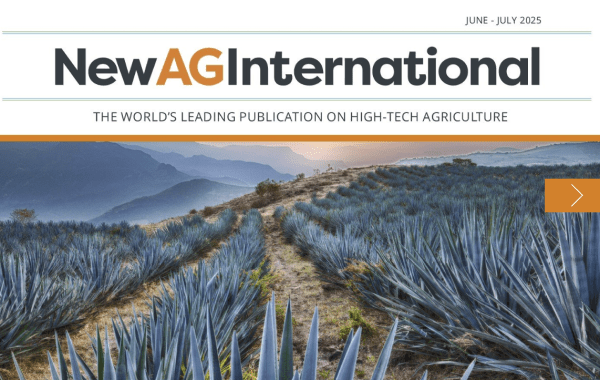
The June/July 2025 issue of the New AG International magazine was another must-read issue from the New AG editorial team – click here to discover more!
• We focus on biological REGULATION and the different approaches around the world.
• Plus, an interview with BiOWiSH Technologies boss Bill Diederich – learn about the company’s microbial additive to liquid and solid fertilizers that boosts nutrient use efficiency.
• And explore Mexico’s agriculture and usage of biologicals. We have a superb report from local agricultural journalist Amado Vázquez Martínez, who also provides a special section on the growing Mexican wine sector.
Overview: How to navigate the global landscape of biopesticide regulation? It’s not easy given the global landscape of biopesticide regulation is anything but uniform. María García-Catalán, Judith Pascual, Ferrán Soldevila, and Mayte Fernández are an expert team to lay out the routes available. While countries like Brazil and the United States have embraced more efficient regulatory processes to accelerate the commercialization of these products, the European Union remains mired in complexity. The result? Fewer biopesticide registrations and slower access for farmers across the EU – a paradox, given Europe’s leadership in green policy rhetoric.
Kevin Helash, CEO of Biotalys, offers some critical insight: innovation in biopesticides is occurring, but regulators aren’t talking to one another. His call is for clarity, consistency, and international coordination. The regulatory ecosystem for biopesticides today resembles a patchwork quilt, full of holes that trap innovation instead of enabling it.
Meanwhile, Dr. Minshad Ansari, founder of Bionema and a vocal advocate for reform through the World BioProtection Forum, shines a spotlight on the UK’s lagging system. Despite laudable intentions in the revised National Action Plan (NAP) for the Sustainable Use of Pesticides (2025), it lacks actionable steps for integrating biologicals into mainstream agricultural practice. As Ansari rightly points out, integrated pest management (IPM) strategies cannot succeed without access to a strong pipeline of approved biopesticide products. Regulation that fails to keep pace with innovation is not just a bottleneck – it is a missed opportunity for sustainability.
Elsewhere the issue is brimming with editorial highlights. Here they are with links:
BIOSTIMULANTS
25-year review highlights surge in biostimulant research for wheat crops
A new comprehensive review spanning 25 years of field-based research has shed light on the growing role of biostimulants in boosting wheat productivity, resilience and sustainability amid intensifying climate pressures. Janet Kanters reports.
India’s path to creating a biostimulant regulatory framework
An administrative deadline has been looming in India regarding biostimulant legislation – the 16th of June. But why does this date have particular significance? The story goes back to the very origins of biostimulant regulation in India. Luke Hutson writes.
Biostimulant News
Koppert transfers biostimulant, fertilizer portfolio to REKA / AlgaEnergy receives CE marking for four new biostimulants / Cultiva receives EU biostimulant registration for Parka / MAFA Bioscience obtains CE certification for biostimulant product / Mosaic Biosciences launches Neptunion in China / New biostimulant treatment boosts wheat yields, studies confirm / New project considers role of seaweed to improve crop fertiliser use / Positive results using biostimulant with seed potato / UOS, DAVAS Prime form research partnership
Bridging the regulatory divide
As global agriculture embraces the biological revolution, a critical challenge looms large: navigating a regulatory labyrinth that threatens to stall innovation and fragment global markets. Janet Kanters speaks with Kevin Helash, CEO of Biotalys and a seasoned veteran in agtech, and one of the leading voices calling for clarity, consistency and realism in the regulatory frameworks that shape the future of crop protection. Read.
How are biopesticides brought to market around the globe?
By María García-Catalán, Judith Pascual, Ferrán Soldevila, and Mayte Fernández, Bioregulatory Services, S.L.
Southern Africa’s biopesticide regulatory landscape
Southern African nations are grappling with a complex and critical challenge: how to effectively regulate and promote the use of biopesticides. A recent multi-country study has shed light on the legislative and regulatory frameworks governing biopesticides in six Southern African countries: Botswana, Mozambique, South Africa, Tanzania, Zambia, and Zimbabwe. Janet Kanters writes.
UK National Action Plan overlooks biologicals
By Dr. Minshad Ansari, CEO and founder of Bionema, United Kingdom, on behalf of the World BioProtection Forum (WBF).
Biocontrol News
Camera traps reveal unexpected predator communities in oilseed rape fields / Extending biopesticide effectiveness by changing pest diet / Canadian researchers target invasive daisies with a moth / Copa Cogeca and IBMA renew five-year roadmap / Futureco and Sumitomo to advance new biological crop protection technology / Amoéba obtains exemption in the Netherlands for AXPERA
Certis Belchim
Certis Belchim launches Growing for the Future project in fruit trees
Found out how the Growing for the Future (G4TF) project in fruit trees provides a route map to sustainable agriculture.
Precision Agriculture News
Compostable sensors could help grow impact of digital agriculture / EU project launched to advance European agriculture through robotics and AR/XR technologies
LEADER PROFILE
BiOWiSH Technologies
In February of this year, Bill Diederich became CEO of BiOWiSH Technologies, which operates out of Cincinnati, Ohio. He spoke with New AG International and laid out his plans for the company and explains why they don’t do single site fermentation.
PRODUCTS AND TRENDS
Liquiadubos inaugurates liquid fertilizer plant in Portugal
This spring, the Portuguese agricultural sector welcomed a new player: Liquiadubos, a domestic company that has inaugurated a factory for NPK-based liquid fertilizers – products containing nitrogen, phosphorus and potassium, essential for the development of irrigated crops. Leonardo Gottems reports.
Products and Trends News
EU tariff increases on Russian fertilizer imports include water-solubles, NPKs, urea / Agropolychim starts construction of new calcium nitrate plant
IRRIGATION
Smart irrigation is smart agriculture
July marks Smart Irrigation Month, a global awareness initiative that recognizes the people, technologies and practices advancing efficient water management. By Natasha Rankin, MBA, CAE, IA CEO.
GREENHOUSE CROPPING
Cuttings dips change the game for greenhouse pest management
For over a decade, researchers in Ontario, Canada have tracked the stealthy spread of pests hitchhiking on unrooted plant cuttings. The problem lies not just in the pests themselves, but in their ability to hide. Many arrive as eggs or immature nymphs, virtually undetectable to the human eye. That’s where cutting dips come in. Janet Kanters writes.
REGIONAL REPORT
Production of high-value crops in Mexico
Although maize, as the main crop in Mexico, is going through difficult times, export crops such as tomatoes, berries and avocado are growing and require more fertilizers. Amado Vázquez Martínez reports.
AGRONOMICS AND ECONOMICS
Agronomics and Economics News
Biofilm Biofertiliser project to offer low-cost alternative to synthetic fertilizers / HGS BioScience acquires Menefee Mining Corporation & Earthgreen Products, Inc. / Wastech Group partners with Pursell Agri-Tech to build CRF facility in Malaysia
PEOPLE
New UK GM at Biobest
BW Fusion names Darren Dillenbeck as CEO
Fertilizer Canada welcomes Michael Bourque as new president and CEO
New Head of R&D for Bayer’s Crop Science Division
Jord BioScience appoints Rob DeWolfe as CFO
SOLASTA Bio makes trio of senior appointments
Pivot Bio appoints Travis Frey as CTO
Frédéric Favrot appointed CEO of Toopi Organics














 Facebook
 Twitter
 Instagram
 LinkedIn
 YouTube