


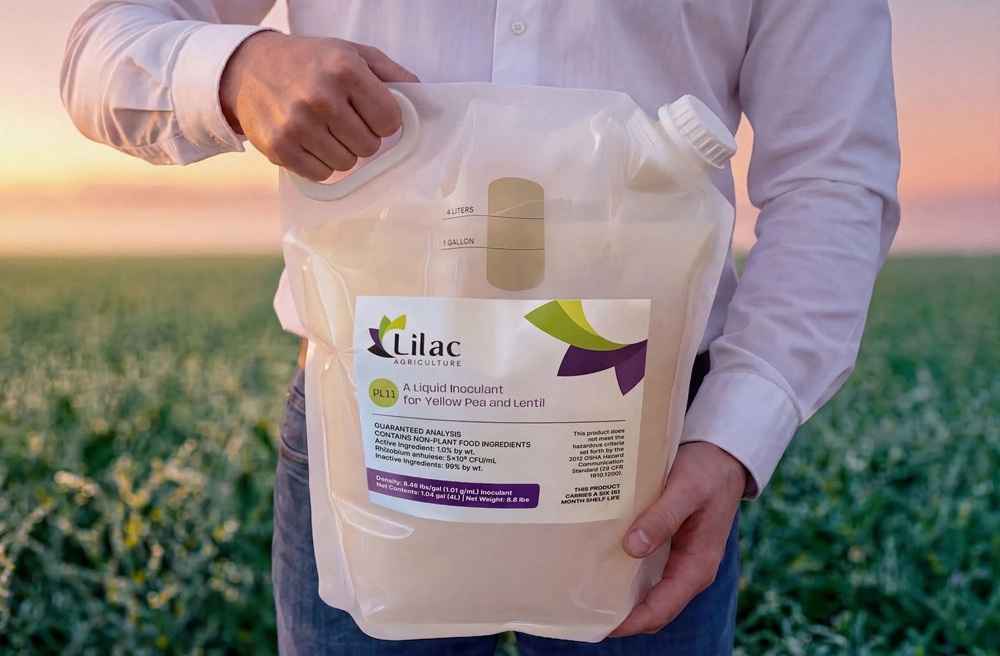
Lilac Agriculture has raised US$2.3 million in an oversubscribed Series Seed financing to expand development and field testing of its rhizobium inoculants for pulse crops.
The Fargo, North Dakota-based company said the financing, led by Innova, was more than 50 percent above its original US$1.5-million target. 701 Fund, Ag Ventures Alliance, Evergreen Climate Innovations, North Dakota Development Fund, Pathway Ventures, Tall Grass Ventures and other investors also participated.
The funding will support expanded field trials and research and development, wider distribution of Lilac’s lead product, PL11, and preparation for entry into the Canadian market.
Rhizobium bacteria form a symbiotic relationship with pulse crops such as peas, lentils and dry beans, allowing the plants to obtain nitrogen through biological nitrogen fixation. Farmers commonly apply rhizobium inoculants to seed each year to establish the bacteria on crop roots.
However, introduced strains must compete with rhizobium populations already present in the soil. According to Lilac, native strains can outcompete commercial inoculant strains for space in root nodules, limiting the consistency of nitrogen fixation and potential yield benefits.
Lilac’s Guided Adaptation platform is designed to address that challenge by selecting rhizobium strains for both nitrogen-fixing ability and competitiveness. The company starts with a diverse collection of strains licensed exclusively from North Dakota State University and adapts them for the soil conditions in which they are expected to be used.
“A better strain doesn’t help a grower if it can’t win the nodule in their own soil – that’s the gap we built Lilac to close,” said Dr. Natalie DiNicola, CEO of Lilac Agriculture.
DiNicola said the new financing will expand Lilac’s field trial program and research pipeline, put PL11 into the hands of more growers across the Northern Plains and support preparation for the Canadian market.
The company’s approach is intended to improve the likelihood that an applied inoculant strain will establish itself on crop roots rather than being displaced by native soil populations.
“A huge amount of untapped variation” exists among rhizobial bacteria, said Dr. Barney Geddes, Lilac’s chief scientific officer, who grew up farming and is a rhizobium researcher with a laboratory at North Dakota State University.
Geddes said commercial rhizobium strains have largely been selected decades ago, leaving opportunities to identify and adapt strains to specific crops and soil environments. Lilac is also measuring nodulation under field conditions rather than relying solely on laboratory assessments, he said.
Lilac’s PL11 product is already being used by pea and lentil growers across the Northern Plains. Early trials have shown strong colonization by the strain at multiple sites, while expanded field trials are underway to assess its performance across a broader range of conditions.
The company is also pursuing Canadian registration. Canada is the world’s largest producer and exporter of both peas and lentils, making the market a significant potential expansion opportunity for the company.
Lilac said its Guided Adaptation platform is designed to support a ptential expansion over time, beyond pulses into row crops, although its initial focus remains on peas, lentils and dry beans in the Northern Plains.















 Facebook
 Twitter
 Instagram
 LinkedIn
 YouTube