

By Janet Kanters
A biological control program led by Spain’s Valencian Institute of Agricultural Research (IVIA) is delivering promising results against the Asian citrus psyllid in Cyprus, offering a potential model for protecting Mediterranean citrus production from huanglongbing (HLB).
IVIA said ongoing monitoring shows substantial reductions in populations of Diaphorina citri, the insect that spreads the bacterium associated with HLB, a disease widely regarded as the most destructive threat to citrus production worldwide.
The findings were reviewed during a meeting between Ángel Marhuenda, Director General of the Common Agricultural Policy, and Cypriot authorities during a recent visit to Cyprus. The discussions focused on the status of the control program, ongoing monitoring efforts and future cooperation on preventing the spread of HLB in the Mediterranean region.
“The results obtained to date show that the classic biological control program is having a very significant impact on Diaphorina citri populations in Cyprus,” said Marhuenda. “However, the detection of residual populations of the vector indicates that it will be necessary to maintain surveillance, especially during the main outbreak periods.”
“The Cyprus experience constitutes a case of great strategic value for Mediterranean citrus farming, allowing the potential of classical biological control to be evaluated in real conditions as a preventive and sustainable tool against one of the greatest phytosanitary threats to citrus fruits,” he added.
Although HLB has not been detected in the Mediterranean basin, the discovery of Diaphorina citri in Cyprus in 2023 marked the first confirmed presence of the pest in the European Union, prompting an international response involving researchers and regulatory authorities.
Cyprus launched an eradication and monitoring program following the detection, working closely with IVIA. Because citrus trees are widely distributed across commercial orchards, private gardens, urban settings and recreational areas, authorities determined that chemical controls alone would not be sufficient.
IVIA proposed supplementing those efforts with a biological control program using the parasitoid wasp Tamarixia radiata. The initiative began in 2024 with support from the Cypriot government, the Agricultural Research Institute of Cyprus, the University of California Riverside, the California Department of Food and Agriculture and other scientific and plant health organizations.
The first releases of Tamarixia radiata took place in spring 2024 at four citrus-growing locations where psyllid populations had been confirmed.
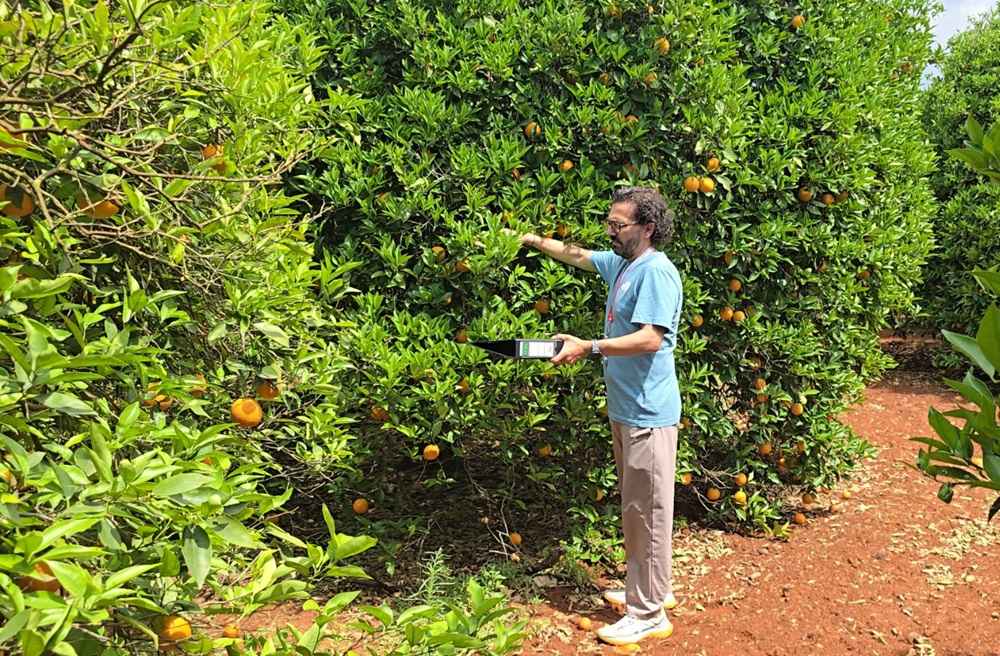
Since then, IVIA researcher Alberto Urbaneja has led a series of scientific missions to assess the program’s progress, with field visits conducted in November 2023, March 2024, July 2024, October 2025 and May 2026.
“The first samplings showed high population pressure of the psyllid, with overwintering adults, abundant nests and heavily infested shoots. In July 2024, some fields even reached 100 percent infested shoots, which confirmed the wide distribution of the vector on the island and the need to reinforce a sustainable management strategy based on biological control,” Urbaneja pointed out.
Monitoring conducted in October 2025 showed a sharp decline in psyllid numbers across most surveyed sites, accompanied by high levels of parasitism where the pest remained present.
“Subsequent monitoring showed a very favorable evolution. In October 2025, a strong reduction in Diaphorina citri populations was observed in most of the monitored fields, along with very high levels of parasitism in the foci where the psyllid was still detected,” adds the expert.
In one of the most heavily affected fields, parasitism levels exceeded 90 percent, demonstrating the effectiveness of the introduced natural enemy.
The latest assessment, completed in May 2026, found further declines in psyllid populations. Most surveyed orchards showed spring growth free of active psyllid colonies, with no significant numbers of adults or nymphs detected. Researchers reported only isolated adults, eggs and small nymphs on very young shoots, with population levels now far below those observed in 2024.
IVIA said continued monitoring will be essential to ensure the long-term success of the program and to support efforts to keep HLB out of Mediterranean citrus-growing regions.










 Facebook
 Twitter
 Instagram
 LinkedIn
 YouTube